Set 8 - Quarter 2
Dinner, Drywall, Deflowerings, & Daily Steps

Hello from SapphicSavvy!
Quarter 2 of Set 8 is in the books, which leaves two and a half Sets in Heat 1 and a genuinely unserious amount of money still sitting on the table. Play your rounds.
This week: dinner, drywall, step counts, and which of you has been somebody's gay awakening.
Let's get into it.
🍳 Four Nights and a Bag of Frozen Dumplings
The typical user makes dinner at home right around 4 nights a week. Respectable! Cozy, even.
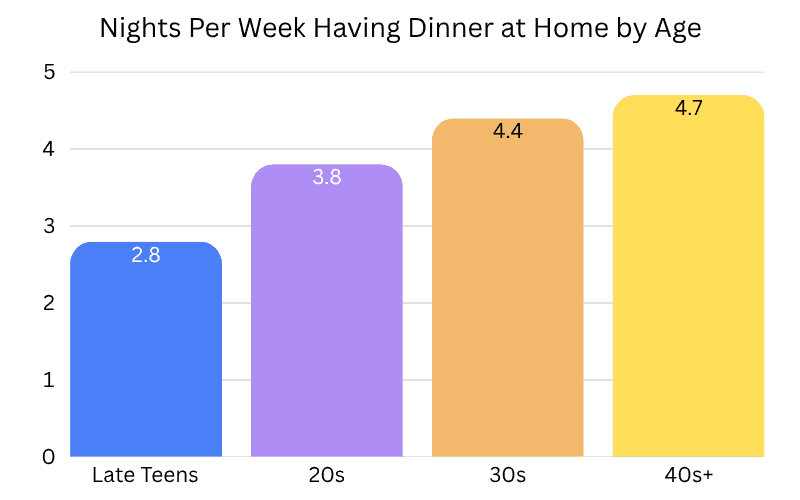
This is one of the cleanest staircases we've ever gotten. Late teens at 2.8, 20s at 3.8, 30s at 4.4,
40s+ at 4.7. Every step up in age buys you roughly half a night of home cooking. Give it four more decades and you'll be making dinner at home eight nights a week.
The late teens number isn't a moral failing, it's a real estate problem. Making dinner requires a kitchen you actually control, and if you're 19 you are sharing that kitchen with a dorm, four roommates, or a mother with opinions about the stove. Nationally this checks out too: 18–24 year olds are close to three times as likely as any other age group to say they never cook dinner at all. So our teens are outperforming their demographic while living in a building with a communal microwave.
For the rest of us, the newer national panels put Americans at about 3.6 cooking sessions a week, with the most common answer in survey after survey landing at 3–4 nights. Older government data ran closer to 5 household dinners, but that's counting the whole household, which is a different question. Either way, we're at or a touch above the national read. The gay 20s are a takeout economy but everybody eventually finds the sheet pan.
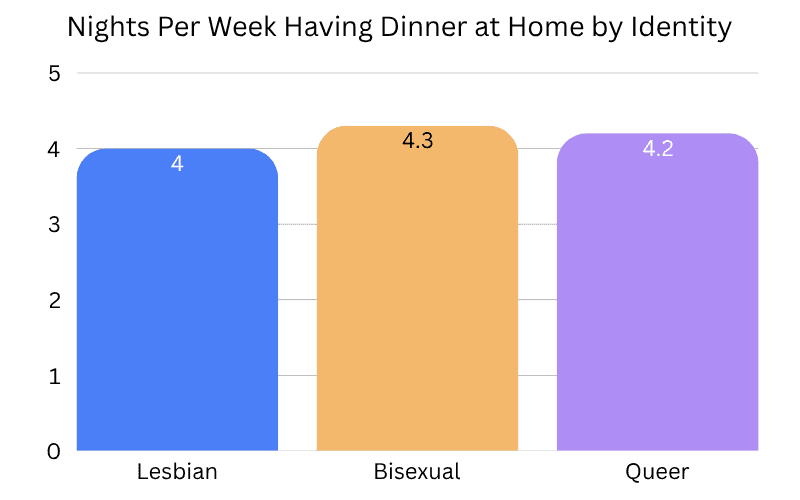
By identity: lesbians 4.0, queer users 4.2, bisexual users 4.3. That is a spread of 0.3 nights, which is one takeout order and a rounding error.
Nobody wins this one. We all cook basically the same amount and we're all lying about how much of it is scrambled eggs.
🔨 The Summer of the Caulk Gun
Just over half of you did some kind of home improvement project this summer.
Now let's put that next to Set 2 Quarter 1, when 79% of users said they were handy enough to do at least minor household repairs. So of everyone who says they can, about seven in ten actually did, in one single summer. That is an extremely high conversion rate from stated capability to executed labor. My gym membership could never.
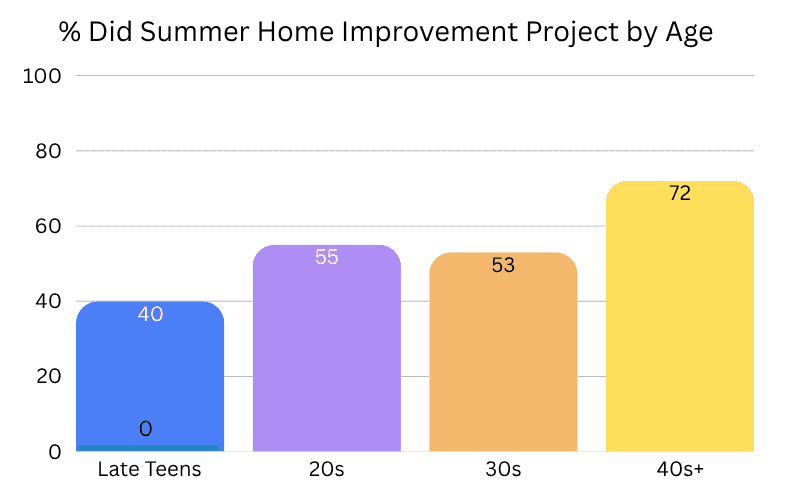
Users 40+ ran away with it at 72%. The 20s came in at 55%, the 30s at 53%, and late teens at 40%. The 20s–30s gap is small enough that I wouldn't bet money on it being real, but I do enjoy the image of the 30s group looking at a peeling doorframe, calculating the security deposit math, and walking away.
They also lowballed themselves, badly. The 40s+ group guessed 59% and then turned in 72%. That is thirteen points of sanding, shelving, and grout they apparently forgot they did. Every single one of them thinks their own summer was the quiet one and that everyone else spent June in an aisle at the hardware store.
And here is the part that actually makes this number interesting. Only about half of LGBT adults own their homes (49.8%, per Williams Institute analysis), compared to just over 70% of non-LGBT adults. The Urban Institute pegged the gap at about 20 percentage points, with roughly half of that explained by age alone. Which means a majority of our users did a home improvement project this summer on property that a majority of our users statistically do not own.
We are out here appreciating our landlords' assets for free. On a Saturday. With our own drill.
Absolutely gorgeous behavior, please stop.
(Late teens at 40% deserves its own shoutout, given that "your home" for that group is frequently "your mother's home." Forty percent of you sanded something that isn't yours and won't be. Sisyphus with a paint roller.)

Lesbian and queer users tied at 59%, with bisexual users 14 points back at 45%. Before anyone builds a stereotype out of this: this was far and away the most age-driven question of the quarter, and group composition can do a lot of quiet work on a number like that. I'd want another quarter of data before I accuse anyone of not owning a level.
🚶♀️ 5,600 Steps and a Theatre Degree
The typical user gets somewhere around 5,600 steps a day.
Context, and this one's a win: accelerometer studies put the average American woman somewhere in the 4,900-step range, and Stanford's giant 2017 smartphone study put the global average right around 5,000. So we're beating the national baseline by roughly 700 steps, or about a third of a mile. Small victory lap. Which itself is like 400 steps.
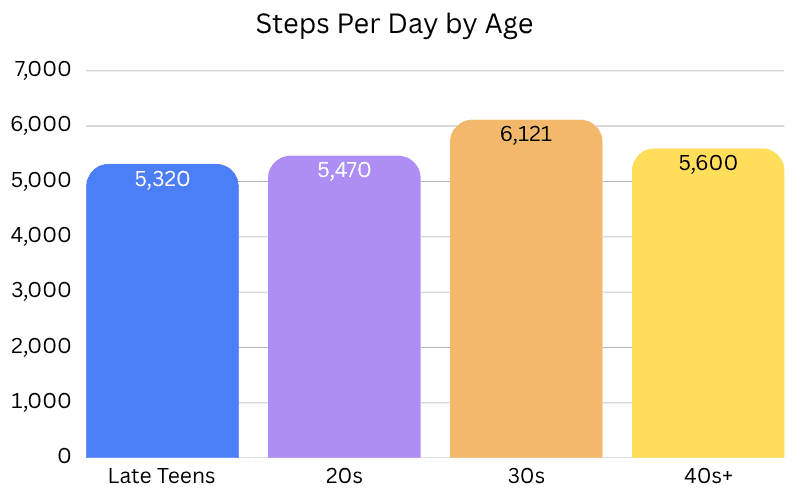
Age-wise the 30s took it at 6,121, followed by 40s+ at 5,600, 20s at 5,470, and late teens at 5,320. The whole range is under 900 steps wide, so nobody is dramatically out-walking anybody.
But I need to show you something. There's a Finnish study of working-age adults that ran the numbers on where step counts start correlating with actually feeling healthy, and the cut-point for "perceives own health as good" came out to 6,123 steps a day.
Our 30s group hit 6,121.
Two steps. Two! Go to the kitchen and come back, I'm begging you. For the mortality curve, the bigger benchmark is the Women's Health Study, which found benefits climbing until about 7,500 steps a day before leveling off, so there's room for all of us. This is not a directive, walking is not a moral test, and bodies and health situations vary enormously. But a brisk 15-minute walk is roughly 1,500 steps and it's free.
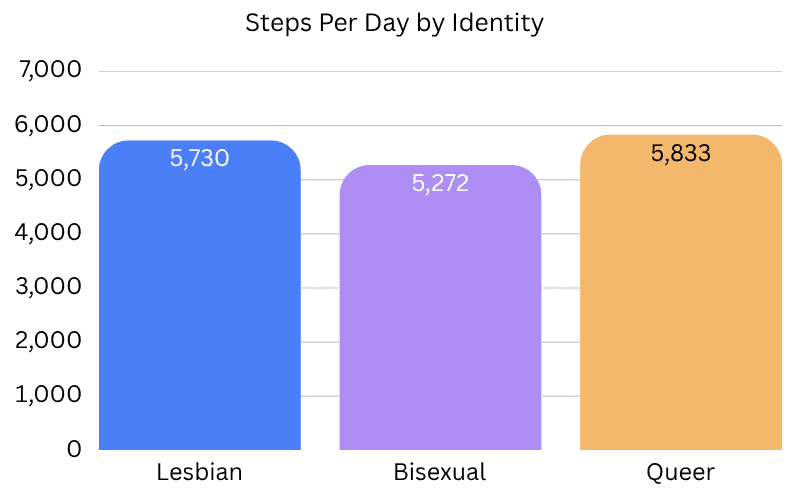
Queer users led at 5,833, lesbians close behind at 5,730, bisexual users at 5,272.
Honestly none of this should shock us. We reported 25% varsity sports participation back in Set 3 Quarter 1, over 80% of us picked arts and crafts and theatre over athletics in Set 6 Quarter 2, and we managed under one camping trip a year in Set 6 Quarter 4. The data has been telling us we're theatre kids for eight Sets straight.
Also, and I cannot let this go: in Set 3 Quarter 3 you told us the typical user has traveled 571 miles to see someone they were dating. We will drive across four states for a girl but we will not walk to the corner. The car is doing so much heavy lifting in this community.
💋 Somebody's First
Just under 60% of users have been someone's first sapphic sexual experience.
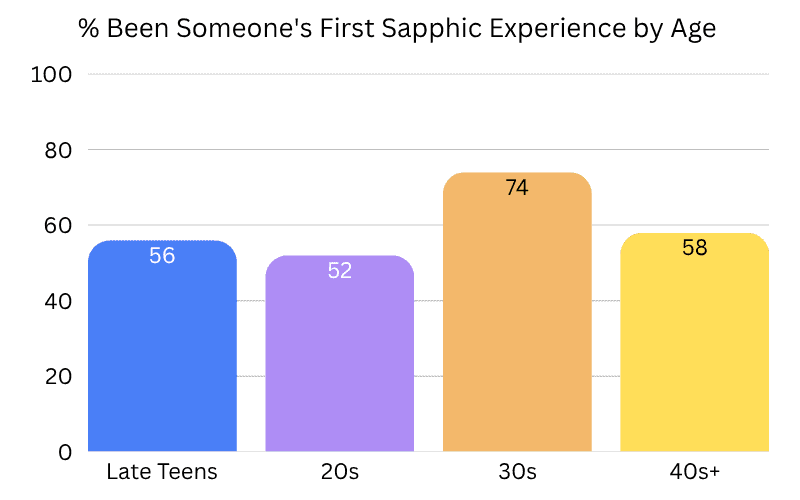
Late teens 56%, 20s 52%, 30s 74%, 40s+ 58%. That 30s spike is enormous and it is not the first time.
Let's review the tape on the 30s: highest rate of ever being in a polyamorous relationship (Set 5 Quarter 2), highest squirting rate (Set 4 Quarter 3), highest rate of 3+ orgasms in one session (Set 6 Quarter 3), highest hard drug use this past summer (Set 6 Quarter 3), and now the most steps and the most gay awakenings in the quarter. At a certain point we stop calling this a coincidence and start calling it a decade.
The boring explanation is partner count. Back in Set 6 Quarter 2 the 30s reported about 11 lifetime partners. More partners, more chances to be somebody's first. Except the 40+ group reported more partners (just over 12) and came in 16 points lower here, so volume isn't the whole story. My read is that it's about who's in the pool with you. Your 30s are the sweet spot where you're experienced enough to be the confident one in the room and still dating a steady supply of people who figured it out late. By your 40s, more of the people you're dating have been out for twenty years and don't need a tour guide.
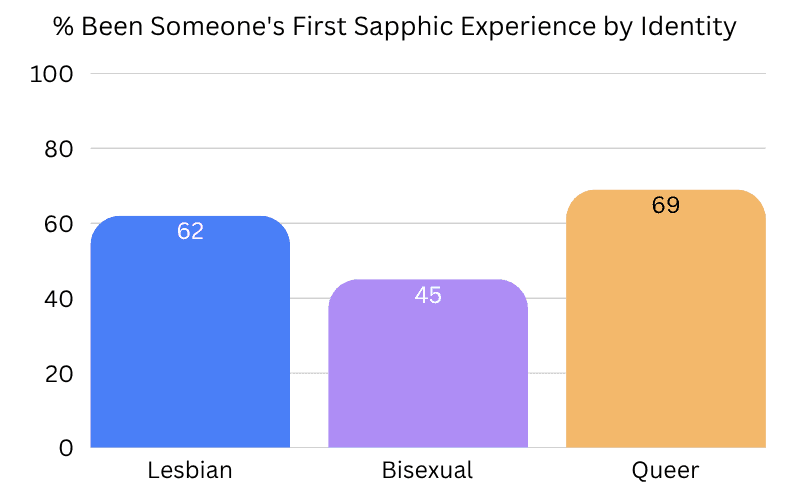
Queer users at 69%, lesbians at 62%, bisexual users at 45%. The bisexual number has a fairly unglamorous explanation: a meaningful share of bisexual users' partners are men, and a man structurally cannot be your first sapphic sexual experience. It's arithmetic, not a referendum.
Queer users also undersold themselves here, and by a lot. They guessed 56% and came in at 69%. Thirteen points of gay awakenings they do not remember facilitating, which might be the most in-character finding in this entire dataset. Nobody hands themselves the title of somebody's first. You find out three years later at a party, when she introduces you to her wife.
Now for the number that makes this whole question make sense. National data has about 17% of women aged 18–44 reporting any same-sex sexual contact in their lifetime, while over 92% of women identify as straight. Sit with that gap. The population of women who have a first time is vastly larger than the population of women who stick around and put a label on it. Which means a comparatively small group of out sapphics is fielding a very large volume of first times, and each of us ends up doing it more than once. That's why this number is 58% and not 20%.
And it's the exact same phenomenon we measured last week from a different angle. In Set 8 Quarter 1 the typical user had made out with about 1.6 straight-identified women. That was the anecdote. This is the receipt.
Quick sincere beat, and I'm flagging it as sincere on purpose: being someone's first is a genuine responsibility. That experience becomes their reference point for what this is supposed to feel like, sometimes for years. Be communicative, be patient, be kind about it, and don't treat it as a trophy. The old gold star framework spent a lot of energy scoring people on who they hadn't slept with. This is a better metric. This is the community's actual unpaid labor, and roughly six in ten of you have clocked in.
The Thread
Three of this week's four questions were about your house. You cook in it about 4 nights a week, you fixed something in it this summer, and your step count is that of a person who is, broadly speaking, inside it.
The visible version of this community is a bar, a festival, a 12-hour first date, a 571-mile drive.
The actual median Tuesday is a sheet pan, a caulk gun, and 5,600 steps that mostly happened between the couch and the fridge.
Then there's the fourth question. The one outward-facing, social, consequential thing we asked about, and a clear majority of you said yes. You've been the door somebody else walked through.
And that didn't happen at a parade or on a dance floor. It happened in exactly the kind of apartment the other three questions just described.
So the mythology has the address wrong. We're not a scene. We're a lot of apartments with good lighting and something in the oven.
Go take a walk. 6,123 steps. Do it for the Finns.
XOXO SapphicSavvy
P.s. here's some additional reading if you're so inclined:
Cooking at Home:
• https://www.hellofresh.com/eat/reports/stateofhomecooking
• https://thefamilydinnerproject.org/newsletter/the-state-of-family-dinner/
• https://www.autostraddle.com/category/food/
Home Improvement & Queer Homeownership:
• https://williamsinstitute.law.ucla.edu/publications/lgbt-housing-instability/
• https://www.urban.org/research/publication/why-are-there-gaps-lgbtq-homeownership
• https://www.angi.com/press/2024-state-of-home-spending-report
Being Someone's First:
• https://www.autostraddle.com/a-roundtable-our-first-times-having-queer-sex/
• https://www.autostraddle.com/gold-star-lesbian-definition/
• https://www.cdc.gov/nchs/data/nhsr/nhsr088.pdf
Steps & Movement:
• https://pmc.ncbi.nlm.nih.gov/articles/PMC6547157
• https://www.ncbi.nlm.nih.gov/pmc/articles/PMC11425518/
• https://irp.nih.gov/accomplishments/for-older-adults-every-step-counts