Set 8 - Quarter 1
Scissoring, Straights, Skepticism, & Sleep
Hello from SapphicSavvy!
Summer is coming to an end and Set 8 is officially underway, which means only three Sets left in Heat 1 and a nontrivial amount of money still sitting on the table for whoever knows this community best. Play your quarters right.
This week: sex, straights, AI skepticism, and sleep. Four questions that look like they were pulled out of a hat. They aren't, and the guesses are where it gets good, so stay to the end.
Scissoring Scorecard ✂️
We have asked about scissoring before. Way back in Set 2 Quarter 4 we asked how many of you regularly scissor, and the headline then was that perception ran well ahead of reality. This week we tightened the screw and asked a harder question: have you ever actually orgasmed that way?
Call it right around a quarter of you.
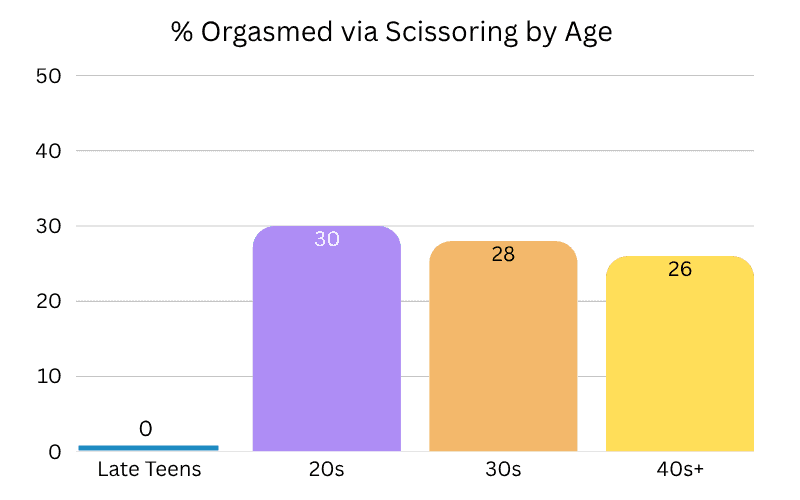
A gentle downhill slope and nothing dramatic. And then the late teens at zero. Not "low." Zero. I'll come back to that, because it deserves its own paragraph and it's the best thing in the dataset.
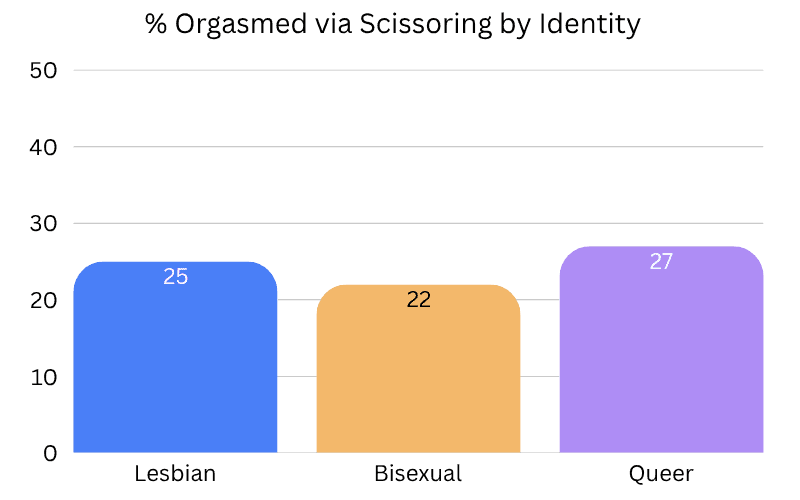
Five points of spread across three groups, which is to say: no spread at all.
Your guesses on this one were good. Within ten points nearly everywhere, which is a rare showing on a sex question — we usually blow the doors off these. You know your community here. Before we go anywhere near a national comparison, vocabulary check, because this is a question where the words matter and almost everyone uses them interchangeably. They are not the same thing.
Tribbing (tribadism, if you're feeling academic) is the broad category: rubbing your vulva against your partner — her thigh, her hip, her stomach, her wherever. One person is in charge of the pressure, the angle, and the pace, and she's grinding against something solid. Scissoring is one specific position inside that category: legs interlocked, vulva to vulva, both people trying to hit the right contact at the same time. We asked about the second one. That is the entire finding, and the research separates them too. Schick and colleagues' multinational survey of 3,116 women who have sex with women found 99.8% reported a history of genital rubbing — functionally everyone — while 90.8% reported scissoring specifically. Both numbers are enormous. But how many people have tried a thing tells you nothing about whether the thing works.
Tribbing works. It works because it delivers sustained, steerable clitoral pressure against a firm surface, which is the most reliable route to orgasm for most people with a vulva, and because exactly one person is driving. Scissoring asks two people to achieve that simultaneously, at an angle, while balancing, in a position where neither of you has full control of the pressure. It's a two-player rhythm game with no difficulty setting. So our 25% is not a report card on sapphic sex. It's a report card on one position. Ask us "have you ever orgasmed from tribbing" and I would bet actual money the answer starts with a 7 or an 8. We asked about the scissors, and the scissors are hard.
And to be extremely clear that nobody here is underperforming: the big U.S. orgasm study by Frederick and colleagues, over 52,000 respondents, found 86% of lesbian women usually or always orgasm during partnered sex, versus 65% of straight women. Set 6 Quarter 3 already told us nearly 60% of you sapphics have had three or more in one session. This community finishes. It's just not finishing that way, and porn has had the wrong position on the poster for about forty years.
Now the zero. Our late teens reported a 0% rate — and guessed 26%.
Sit with that for a second, because it's the cleanest illustration of what this entire app is for that we have ever printed. An entire age group looked around, concluded that about a quarter of their peers were routinely having a specific kind of orgasm, and the real number was nobody. Not one. They were all quietly assuming they were behind on something that literally no one in the room had done. The explanation isn't mysterious, and it's the same one as above. Set 7 Quarter 4 found 63% of our late teens hadn't had partnered sex in the past month, and Set 3 Quarter 2 put the average coming-out age around 19, so a large share of this group is still early. Then stack the hardest position in the repertoire on top of that. Scissoring is not where anybody starts — it's a thing you arrive at after you already know what works, with someone you've had enough practice with to troubleshoot out loud.
The Straight Girl Ledger 💋
Next: how many "straight" women have you made out with. And I want to flag the quotation marks immediately, because they are doing enormous work in this question. Every number below is a snapshot of what somebody was calling herself at the time.
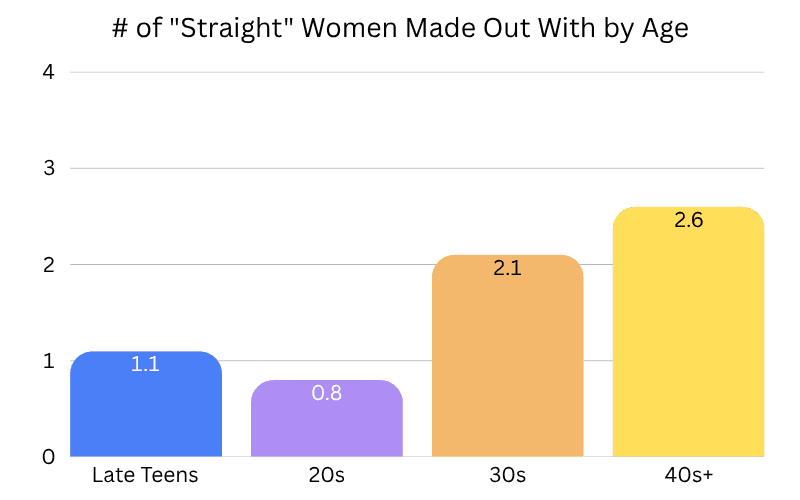
This is a lifetime count, so it should only ever go up, and mostly it does — the 30s and 40+ numbers are accumulation doing accumulation. But look at that dip. Late teens slightly outscore the 20s. My simple read: the late teens are counting recent inventory. High school, freshman year, the party, the dare, the friend. It's fresh and it's countable. By your mid-20s a lot of you are out, plugged into an actual community, and the people you're kissing are people who call themselves something. The pool changes and the tally stalls.
The 40+ number has a different mechanism behind it, and it's a little sad and a little heroic. For a lot of our older users, the available dating pool was women who identified as straight. Not because they were experimenting — because coming out was more expensive then. The GSS shows this in the cohort data: among women born before 1965, fewer than 5% report having had sex with both men and women since 18. Among women born between 1984 and 2000, it's over 20%. The category expanded. Our 40+ users were doing fieldwork before the category existed.
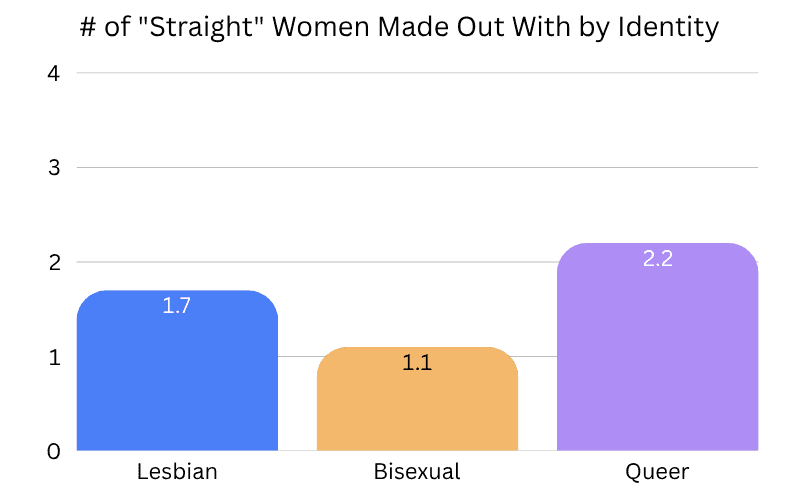
Queer users doing the MOST once again but not by much this time. Bisexual users lowest is the one worth pausing on, because it's the opposite of what the stereotype predicts. Two things, maybe going on here. First, a meaningful share of bisexual users' romantic activity isn't with women at all, so the denominator is smaller than it looks. Second, and I suspect this is the bigger one, bisexual users may simply be more careful with the label. If you have personally been told your identity is a phase (Set 6 Quarter 3, where bisexual users caught that comment at real rates), you're probably less inclined to file another woman under "straight" on the strength of what she announced at a party.
Here's where the guesses turn: you overshot this one by a full 1 to 1.5 women across every subgroup. Which means we all believe the sapphic-kisses-a-straight-girl story is roughly twice as common as it is. That tracks, and the culprit here is similar to the one we blamed for some of our previous misperceptions: stories that we hear from friends and those that get depicted on screen. Example: the straight-girl makeout story has a plot, a twist, and an eager group chat waiting for it. In contrast, no one is out here recounting all the straight women they have failed to lock lips with. Selective attention and retention remain undefeated in fucking up our perceptions of reality.
National context, and this one genuinely reframes the question. In the NSFG, about 17% of women aged 18–44 report any same-sex sexual contact in their lifetime, nearly three times the rate for men. And of the women who've had a same-sex encounter, roughly 65% identify as heterosexual. Separately, estimates put the share of straight-identified college women who've kissed another woman at a party somewhere between 20% and 33%. So most women who've had a same-sex experience call themselves straight. Which means this question measures less about your conquests and more about how the country files its paperwork. Set 3 Quarter 4 found most of you were googling girls kissing before you came out. Welp, some of those girls were googling too.
Artificial Anxiety 🤖
Okay. Our agreement here is perhaps the highest that we’ve seen for anything we’ve asked about in this game. Yes, that’s right at this very moment, a greater proportion of sapphics are anxious about AI than are currently sporting a carabiner or wearing docs.
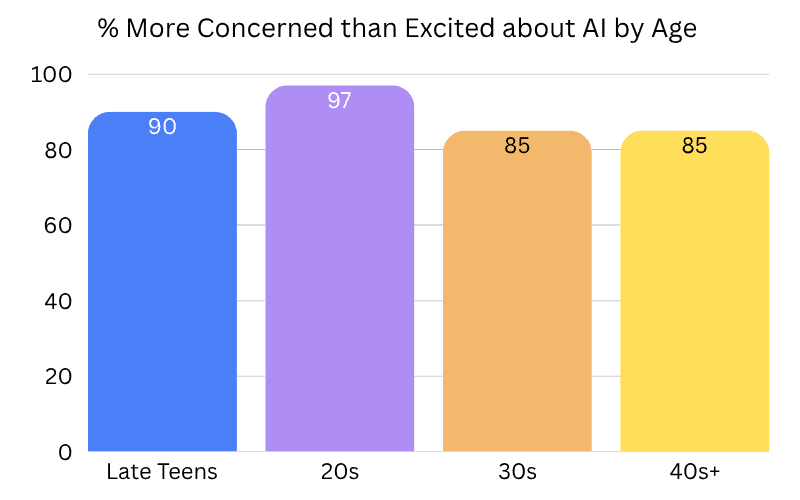
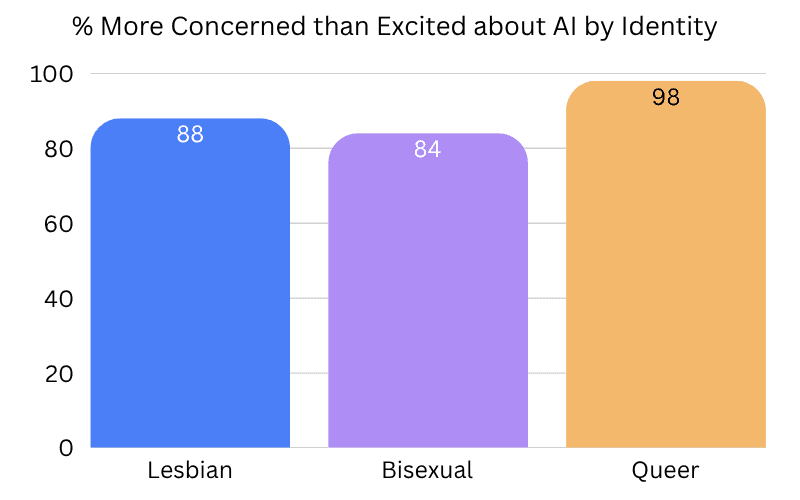
Nationally, Pew's most recent read has 52% of U.S. adults saying they're more concerned than excited about AI, with 9% more excited and the rest split down the middle. By age: 55% for 18-29, 51% for 30–49, 47% for 50–64, 59% for 65+.
Our least worried group sits 26 points above the most worried group in America. Our queer users are at 98%, which is not a majority, it's a consensus with two people out sick. We've also inverted the national age pattern. Out in the country, worry climbs with age — the 65+ crowd is most concerned, under-30s least, though that gap has been closing fast and under-30 concern crossed a majority for the first time this year. In here it's flipped. Our 20s are the most alarmed group in the entire dataset at 97%. Our 40+ users are the calmest. Three guesses and I like all of them.
Exposure. Set 4 Quarter 3 established that younger users are on more social apps daily. The slop is on the apps. If your feed is where you live, you've watched it degrade in real time and you didn't need a much more evidence.
Labor. Set 6 Quarter 2 found over 80% of you prefer arts, crafts, or theatre to sports — over 90% among queer users. This is an overwhelmingly arts-inclined community, and generative AI's most visible early move was to eat exactly that. You are not a neutral observer of a technology built by scraping the thing you make. Moreover, the economy already sucks and entry-level jobs are hard to come by, particularly for young people. While the elders among us may be comfortably concerned about AI taking their existing jobs, the youngins are out here struggling with the prospect of AI stealing all the real jobs before they can even get a foot in the door. This worry seems warranted.
Stakes. This is the one I'd point at for the queer number specifically. Autostraddle ran a piece on how AI erases queer content, citing analysis finding that image models prompted for queer and trans people returned, essentially, stereotypes and smut. Researchers have separately found that trans, nonbinary, and disabled people in the U.S. view AI considerably more negatively than dominant groups. The queer label in our data carries a lot of gender-expansive folks — I made this point in Set 7 Quarter 4 about medication rates and it applies just as cleanly here. When systems that categorize people get built by companies that also answer to governments, being hard to categorize stops being abstract.
And then the guesses, which are the single strangest result of the quarter: you underestimated this by 20 to 25 points across every subgroup. Read that again. A community sitting at 88 to 98% concern collectively believed it was sitting somewhere around 65 to 75%. Almost everyone here is worried, and almost everyone here thinks they're way more alone in their worry than they really are. Pluralistic ignorance is the academic name for this phenomena where everybody privately holds a position while self-consciously assuming they're one of the few holding it. If you've been softening your AI concerns at the sapphic friend dinner because you assumed you were the outlier at the table — you were actually the table.
In summary….
We were collectively under the impression that fellow sapphics sleep less and make out with more straight women than is truly the case. We also estimated fewer of us to be freaked out about AI than we really are. And a whole age group thought a quarter of their peers were having a type of orgasm that exactly none of them have actually ever had.
We are collectively running a PR campaign for a version of ourselves that does not exist, and then quietly measuring ourselves against it. The real one sleeps seven and a half hours, is weary of the chatbots, and has never once orgasmed with her legs in a pretzel. She's fine. She's great, actually.
Sweet dreams,
XOXO SapphicSavvy
P.S. additional reading if you are down for it
Scissoring & the Orgasm Gap:
https://www.autostraddle.com/41-feelings-you-had-about-scissoring-286637/
https://greatist.com/happiness/scissoring
https://link.springer.com/article/10.1007/s10508-017-0939-z
Straight Girls & Same-Sex Behavior:
https://www.psypost.org/why-do-straight-women-kiss-at-parties-motivations-for-same-sex-performativity-revealed-in-new-study/
https://contexts.org/blog/womens-queer-sexuality-in-college/
https://www.cdc.gov/nchs/data/nhsr/nhsr088.pdf
AI & the Queer Community:
https://www.autostraddle.com/how-ai-erases-queer-content/
https://www.pewresearch.org/short-reads/2026/08/18/young-adults-in-the-us-are-increasingly-wary-of-ai-concerned-it-will-take-jobs/
https://www.pewresearch.org/science/2025/09/17/how-americans-view-ai-and-its-impact-on-people-and-society/
Sleep:
https://news.gallup.com/poll/642704/americans-sleeping-less-stressed.aspx
https://www.cdc.gov/nchs/products/databriefs/db559.htm
https://www.tandfonline.com/doi/full/10.1080/15402002.2019.1591410