Set 8 - Quarter 3
Sin, Strays, STIs, & Stress Drinking

Hello from SapphicSavvy!
Quarter 3 of Set 8 is done, which makes this week the last round of the Set. Whoever wants that Set prize, now is the time. Play your round.
This week: church, strays, STIs, and the drink you poured after a bad day. Heavier than usual.
We'll get through it together.
🙏 Forgive Me Mother, For I Have Sapphed
Roughly two in three of you have dealt with religious guilt at some point in your lives.
Two in three. That's not a subgroup. That's the room.
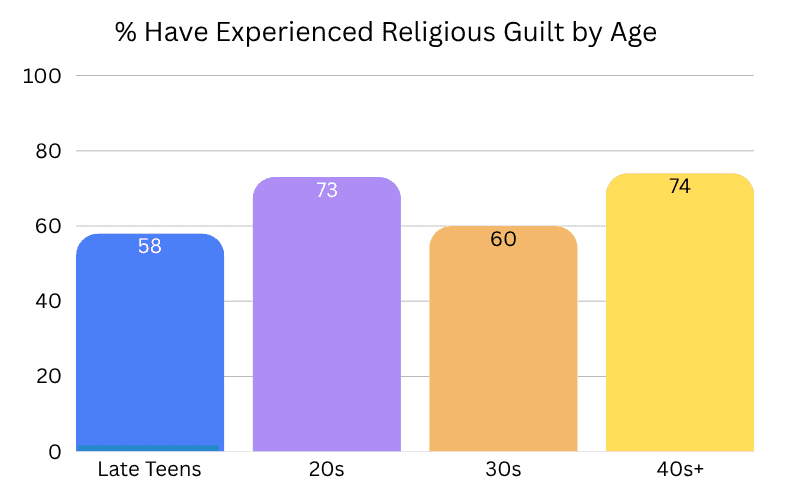
And the age chart is doing the cha-cha. Late teens 58%, 20s 73%, 30s 60%, 40s+ 74%. Up, down, up.
The 40s+ number is the least mysterious. If you grew up in the 80s or 90s, church wasn't really a lifestyle choice so much as the default setting for a Sunday, and the messaging about people like us was not subtle.
The 20s number is the interesting one. Your 20s are when a lot of us move out, come out, and finally have the private square footage to sit with what we were taught as kids. That's reckoning season. And PRRI's data backs it up hard: six in ten religiously unaffiliated Americans under 30 say they left their childhood religion over its teachings and treatment of LGBTQ people. That drops to about half for people in their 30s and 40s, and to around 35% for the oldest group.
Young people aren't drifting out of church. They're walking out, and a lot of them are citing us as the reason.
Late teens at 58% might just be a timing thing. Some of you are still living under the roof where the guilt is manufactured, and it's hard to name a thing while you're standing in it. Also, fewer of you were raised in religion to begin with. Give it a few years and a therapist and we'll see where that number lands.
Then there's the 30s, dipping to 60%. Our resident chaos cohort. The group that has led us on polyamory (Set 5 Quarter 2), multiple orgasms (Set 6 Quarter 3), and being someone's first (last week, Set 8 Quarter 2). I'm not saying the 30s simply never showed up to confession. I'm saying I wouldn't rule it out.
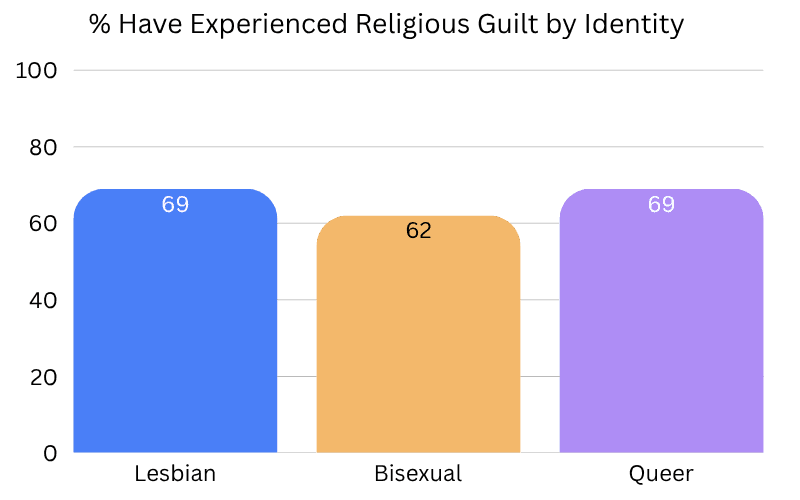
Lesbian and queer users tied at 69%, with bisexual users 7 points back at 62%.
This should feel familiar. Back in Set 6 Quarter 3, bisexual users were a full 20 points less likely to have been told their identity was "just a phase," even though everyone assumed they'd be hit hardest. Same shape here. My best guess is that a lot of religious condemnation is aimed squarely at same-sex relationships. If you're bi, there's often a window where you can postpone that fight, or where the people around you just assume you'll end up somewhere the pastor approves of. That window isn't freedom, and it comes with its own flavor of erasure. But it might mean fewer bisexual users felt the guilt land directly.
For national context: PRRI's big LGBT survey found that LGBT Americans are raised in religion at basically the same rate as everyone else. The difference is in who stays. About 37% of LGBT Americans are now unaffiliated, compared to 21% of the general public, and among LGBTQ people who've left, 73% say they left because of what that religion taught about them. So we walked in the same door as everyone else. A lot of us just got shown the exit.
Quick sincere beat, on purpose: guilt that was handed to you as a kid is not a verdict. It was a lesson someone else chose to teach, and you're allowed to unlearn it on your own schedule. Some of you have found your way back to faith on your own terms, some of you are happily done with it, and some of you still hum hymns while doing the dishes and have complicated feelings about it. All valid. Autostraddle's religion roundtable is a lovely read if you want company on this one (link below).
🐾 Adopt, Don't Shop (And Apparently Don't Stop)
The typical user has somewhere around 1.8 rescued pets in their household.
Now pull up Set 2 Quarter 2, where the typical user had about 2 pets total. Different quarter, different respondents, and I'm not going to pretend this is a controlled experiment. But if those two numbers are even close to describing the same homes, then almost every animal living with a SapphicSavvy user is a rescue.
For comparison, the widely cited APPA numbers put the share of American dogs that came from a shelter at about 23%, and cats at about 31%. Another 27% of pet cats started life as strays.
Most American pets still come from breeders, friends, or somebody's cousin whose cat "had an accident." Sapphics apparently looked at those options and said no thank you, I'll take the one-eyed tabby with a tragic backstory.
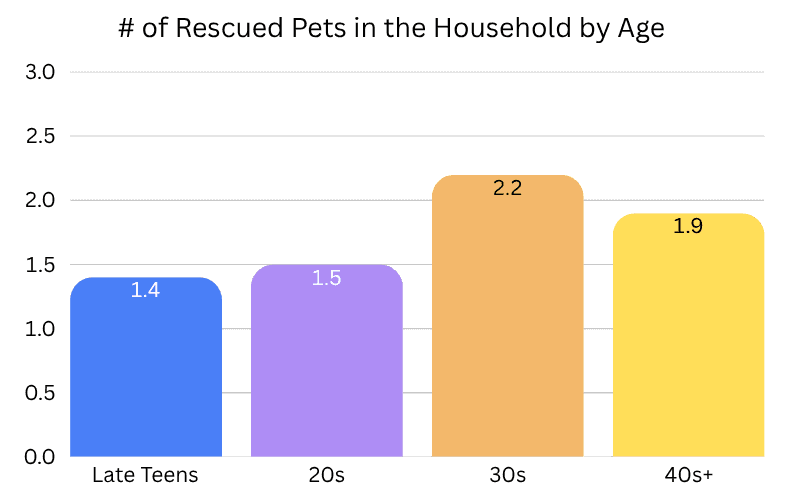
Late teens 1.4, 20s 1.5, 30s 2.2, 40s+ 1.9.
The 30s win again. Of course they do. The same cohort that has been leading us in most things chaotic is also, it turns out, running a small animal sanctuary out of their apartment. Honestly, it tracks. You can't be a menace AND emotionally unavailable to a senior beagle. Pick one.
The younger numbers are a housing story more than a heart story. Younger renters are running into pet restrictions and size limits, and last week (Set 8 Q2) we already established that a big chunk of this community is renting. A landlord with a "one cat, under 15 pounds" clause is doing more to hold down the late-teens average than any lack of love for animals. Once the lease allows it, the second rescue is coming. We know this about you.
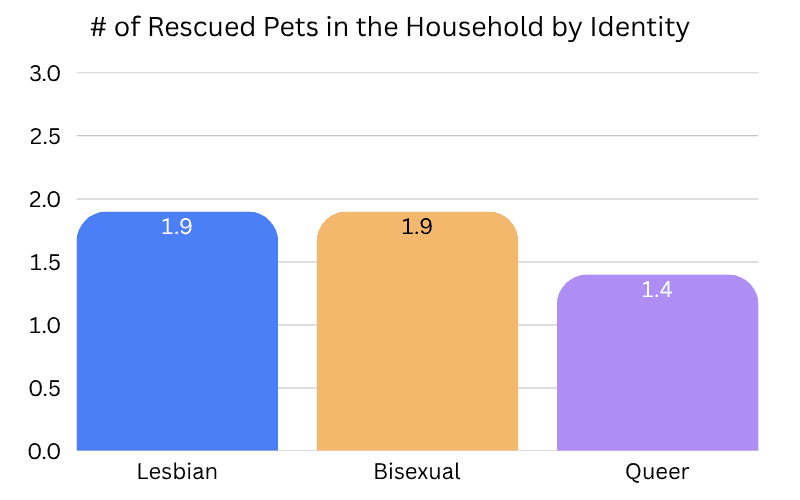
Lesbian and bisexual users tied at 1.9, with queer users at 1.4.
Plot twist! Queer users reported the most pets back in Set 2 Quarter 2, the most plants in Set 3 Quarter 1, and leaned slightly more cat-person in Set 6 Quarter 1. So queer users aren't short on animals. They may just be getting them from somewhere other than a shelter. Cats in particular are often inherited from friends and family, and a cat that showed up on your porch and never left may or may not count as "rescued" depending on who you ask. (It counts. The cat thinks it counts.)
If you're pet-curious: shelters took in about 5.8 million dogs and cats last year. Plenty of them are still waiting. If your lease allows it, you know what to do. If it doesn't, fostering is a thing, and it's a very good gateway drug.
🩺 Nobody Said Scissors Were Sterile
13% of users have contracted an STI from a partner.
You guessed 31.9%.
More than double! Y'all walked into this question assuming nearly one in three of us has been through it. The real number is closer to one in eight. So before anything else: the community is a lot healthier than the community thinks it is.
That said, let's kill the opposite myth too: the idea that sapphic sex comes with zero STI risk. It doesn't. Herpes, HPV, trich, and bacterial vaginosis all travel just fine through skin-to-skin contact, oral sex, fingers, and shared toys. And about that last one, a reminder that back in Set 4
Quarter 1, about a third of you told us you've used the same sex toys with multiple partners. Hi.
We love you. Wash them.
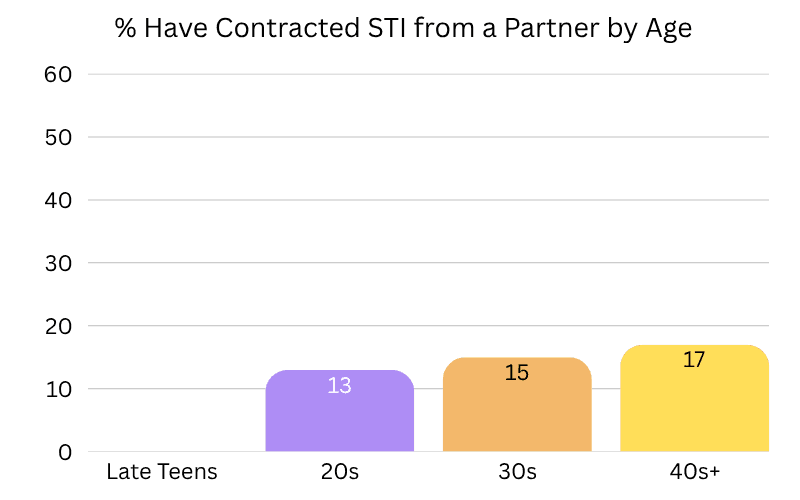
20s 13%, 30s 15%, 40s+ 17%. The late teens bar didn't register at all.
Which makes it extra funny that late teens were the group that overestimated the most. The group with the least real-world STI experience had the scariest mental picture of it. I have a theory, and it's called high school health class. A slideshow of worst-case photos, a teacher saying "and this is what happens," and zero context on how common any of it actually is. That kind of fear lesson sticks around well past graduation. Consider this your update: most people have not had one, and the ones who have are mostly fine.
This is the cleanest staircase of the week, and it's the most boring explanation possible: "ever" questions go up with age because age means more time and more partners. Set 6 Quarter 2 had lifetime partner counts at about 6 for the 20s, 11 for the 30s, and just over 12 for the 40s+. The STI line climbs right along with it.
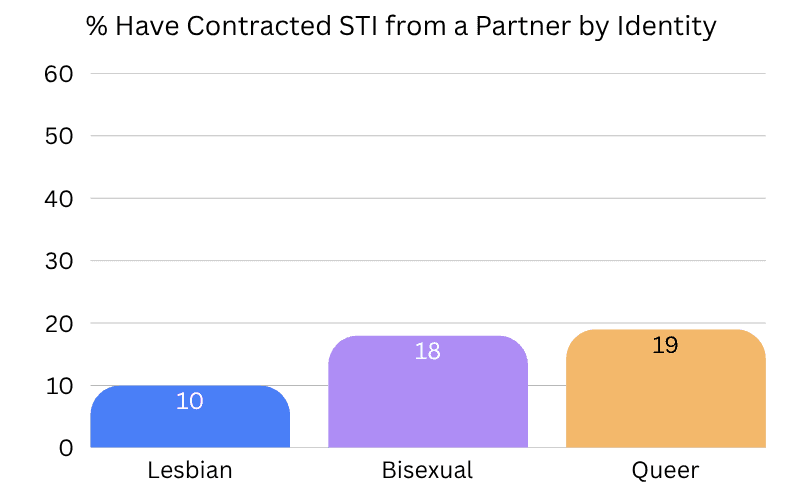
Lesbians 10%, bisexual users 18%, queer users 19%.
Same story, different axis. In Set 6 Q2, lesbians reported the fewest lifetime partners and queer users the most, and the STI numbers fall into exactly that order. Bisexual users also have a meaningful share of partners who are men, and penis-involved sex is simply a more efficient delivery system for a lot of infections. That's biology, not a character assessment.
Bisexual users also overestimated more than any other identity group, and I think I know why.
The "bisexuals get around" stereotype is old, it's loud, and it's wrong. We busted it back in Set 6 Quarter 2, when partner counts turned out to be pretty similar across all three groups. But a stereotype you've heard your whole life can shape your guesses about your own group, even when it isn't true. Bi users: your real number is well below what you expected. The stereotype was never right about you.
The research lines up almost eerily. A national study of women in their mid-20s to early 30s found past-year STI diagnoses at about 7% for gay women, 12% for straight women, and 18–19% for bisexual and mostly-straight women. A Toronto study of women who have sex with women put lifetime STI history at about 19%, with bisexual women more likely and lesbians less likely to report one. Our lesbians at 10% and our bi and queer users at 18–19% look like they could have been copied from those tables.
So overall we're at or below what published research finds. Good news! Except here comes the catch.
Quick sincere beat, flagged on purpose: this question asks what you've contracted, and that's really a question about what you've been diagnosed with. One national study found that women with only female sexual partners had dramatically lower odds of getting an STI test than women with only male partners. So a chunk of that low lesbian number might be real, and a chunk might be that nobody ever checked. Plenty of STIs don't announce themselves. If you've never been tested because a doctor (or the internet) told you sapphic sex was risk-free, consider this your sign. Ask for a full panel. Mention your partners. Dental dams exist. Toys can be covered or washed between partners. You are not being dramatic.
🍷 Pour One Out (For the Group Project)
The typical user drank to cope with work, school, or relationship stress about 1.6 times in the past month.
You guessed 4.5.
Nearly three times the real number. Y'all pictured a community reaching for the bottle about once a week. The actual number is closer to one bad Tuesday every two to three weeks.
That's not alarming on its own. But context matters here, so let's build some.
Back in Set 6 Quarter 2, you told us you had about 25 alcohol-free days in June, so roughly 5 drinking days a month. Different quarter, different people, back-of-the-napkin math. But if both numbers hold, somewhere around three in ten drinking occasions in this community have stress behind them. The overall drinking is modest. The reason for a decent slice of it is less cute.
Now run the guess through the same math. At 4.5 stress drinks against roughly 5 drinking days, the guess basically assumes that almost every time a sapphic drinks, it's because something went wrong. That's a pretty grim picture of us, and the data doesn't support it. Most of our drinking is still dinner, a birthday, or a nice glass of wine on the patio.
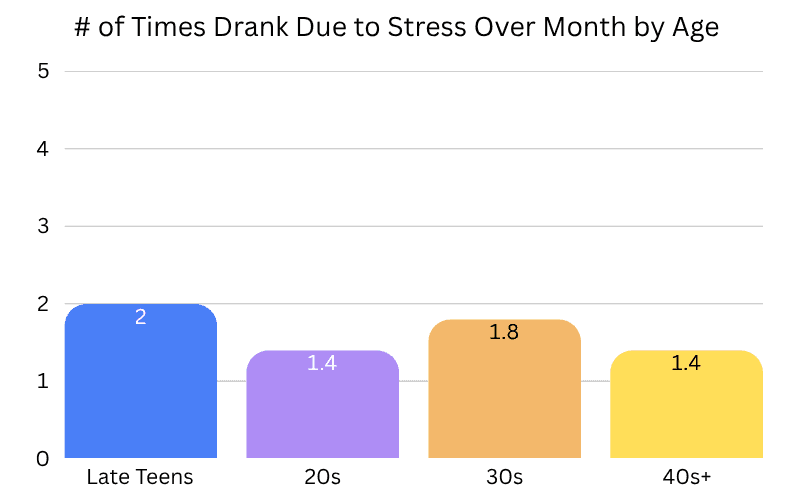
Late teens 2.0, 20s 1.4, 30s 1.8, 40s+ 1.4.
Late teens are leading, and let's gently note that most of that group is not legally allowed to be drinking in the first place. School stress is real and some of you are clearly marinating in it. What makes this spicy is that Set 6 Q2 had our youngest users as the most sober group in the whole community. So younger sapphics are drinking less often, but when they do, it's more likely to be a coping move than a party. Less "let's go out," more "I have three midterms and a situationship."
Late teens also overestimated the most, and by a lot: a guess of 5.1 against a real 2. So the youngest group is carrying the biggest stress-drinking load and the most inflated idea of everyone else's. That combo is worth watching. When you think everyone around you is drinking through their problems five times a month, doing it twice feels like the careful choice. It isn't necessarily. Your peers are not doing what you think they're doing. Most of them are drinking less than you, not more.
The 30s came in second at 1.8, which, honestly, is the most on-brand number of the week. Rescue pets, no religious guilt, and a glass of wine after the 4pm meeting that should have been an email.
The 40s+ are back down at 1.4, and that tracks with Set 4 Quarter 3, where older users were the most likely to meditate or do breathing exercises when stressed. They've found other tools. We could learn a thing.
Lesbians 1.7, queer users 1.6, bisexual users 1.0.
National context: a national survey out earlier this year found that nearly 47% of American adults say they use alcohol or cannabis to cope with stress, and Gallup has only 54% of Americans drinking at all, which is the lowest it's been since Gallup started asking in 1939. So stress drinking is not a sapphic invention. But there's a reason researchers who study our community pay special attention to it. Minority stress theory basically says that the extra load of stigma and discrimination wears down coping resources, which pushes up drinking-to-cope, which pushes up problem drinking. Social drinking and coping drinking are not the same animal.
Last sincere beat of the week: if a drink is your main tool for a bad day, it's worth having at least one other tool in the drawer. A walk (we still need those 6,123 steps from Set 8 Q2). A friend. Therapy, which half of you were already doing monthly back in Set 2 Q2. A breathing exercise the 40s+ can teach you. Our chat. The drink can stay in the rotation. It just shouldn't be the whole rotation.
🧵 The Thread
Read the four questions again. Religious guilt you dealt with. An STI you got from a partner. Stress from work, school, or relationships. Three of the four are about something somebody else handed you.
Guilt from a pulpit. An infection from someone you trusted. A deadline, a boss, a girlfriend in a mood. None of it was your idea. All of it became your problem.
And then there's the fourth question, which runs the other way. A rescued pet is something somebody else gave up on, and you took it home anyway. Nearly two of them, on average. With the one ear and the anxiety and the vet bills. That's the whole community in one chart, honestly. A group of people who got handed a lot of stuff they didn't ask for, and who respond by adopting everybody else's strays. The PRRI numbers say a lot of us got shown the door. The pet numbers say we keep holding ours open.
One more thing, and it's the part I most want you to take away. On both questions where we have guesses this week, y'all went dark. STIs: guessed 31.9%, actual 13%. Stress drinking: guessed 4.5, actual 1.6. Both overshot by two to three times, and in both, the youngest users had the gloomiest picture.
That's the reverse of Set 8 Quarter 1, when our guesses made us look more fun than we are (more sex, less sleep). This time the guesses made us look more damaged than we are. Same problem underneath, though. We guess from the stories that get told, and the stories that get told are the dramatic ones. Nobody posts "got tested, all clear, went to bed." Nobody makes a group chat thread about the stressful Tuesday they handled with a walk. The quiet, fine version of this community is the majority, and it's the version nobody sees.
So this week's homework: put down the guilt that wasn't yours. Get the panel. Find a second coping tool. And give your rescue a treat from us.
XOXO SapphicSavvy
P.s. here's some additional reading if you're so inclined:
Religion, Guilt, and Leaving:
• https://prri.org/research/religious-change-in-america/
• https://prri.org/research/2014-lgbt-survey/
• https://www.autostraddle.com/being-queer-and-spritual-or-not-the-autostraddle-religion-roundtable-194714/
• https://tandempsychology.com/how-to-heal-from-religious-trauma/
Rescue Pets:
• https://www.shelteranimalscount.org/2025-report
• https://petnurture.life/statistics/pet-adoption-statistics-usa
• https://www.autostraddle.com/40-of-lesbians-own-a-cat-so-i-guess-im-dying-alone-432496/
STIs and Sapphic Sex:
• https://www.guttmacher.org/journals/psrh/2013/05/invisible-and-risk-stds-among-young-adult-sexual-minority-women-united-states
• https://pubmed.ncbi.nlm.nih.gov/25477474/
•https://www.sciencedirect.com/science/article/abs/pii/S0091743516303796
Drinking to Cope:
• https://pmc.ncbi.nlm.nih.gov/articles/PMC8511332/
• https://pmc.ncbi.nlm.nih.gov/articles/PMC8982112/
• https://news.gallup.com/poll/713534/americans-drinking-remains-record-low.aspx