Set 7 - Quarter 3
Haircuts, Hand-Holding, and Half the Drinks You Think We're Having

Hello from SapphicSavvy!
Quick housekeeping: we split the late teens out from the 20s on the charts this quarter instead of lumping them together, and it was immediately worth it, because those two groups did not agree on a single thing this week. Anyway. Two of this week's results were pretty normal. Two of them we got so wrong as a community that I want to spend some real time on it. Let's go.
Clip Clip Hooray ✂️
First up: the ceremonial post-coming-out chop. Somewhere in the high 30s overall, depending on how you slice it (sorry).
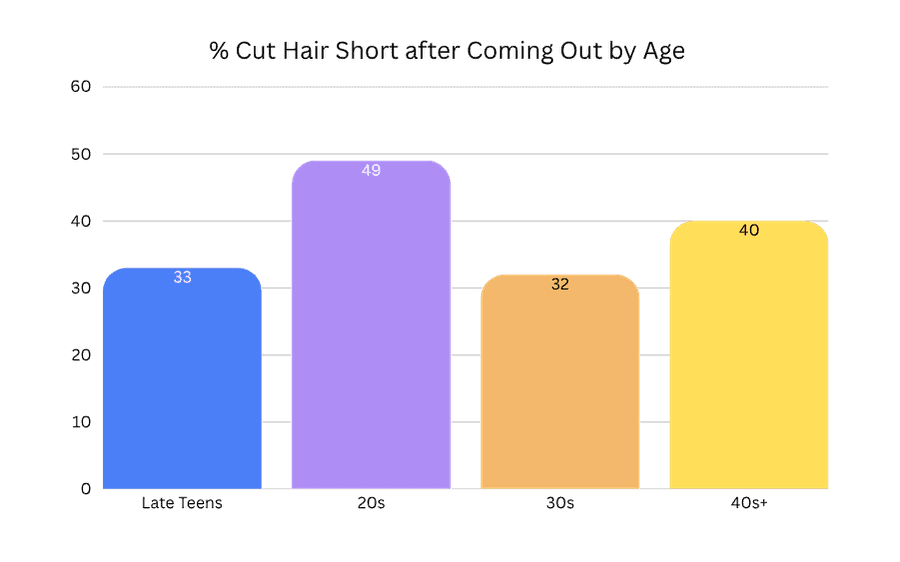
Users in their 20s were the chop-happiest group at 49%, with the late teens at 33%, the 30s dipping to 32%, and the 40+ crowd back up at 40%. So it's a squiggle, not a trend, which I love because it means I get to speculate freely. Here's my read. Back in Set 3 Quarter 2 we found the average age of coming out was around 19. Which means our 20s cohort is standing closest to the event — the haircut is recent, it's specific, they can tell you the salon. Ask someone in their 30s about a decision they made eleven years ago and "dramatically shorter" starts doing a lot of quiet negotiating in their memory. And our 40+ users have simply had more decades in which to walk into a barbershop and say "shorter. no, shorter."
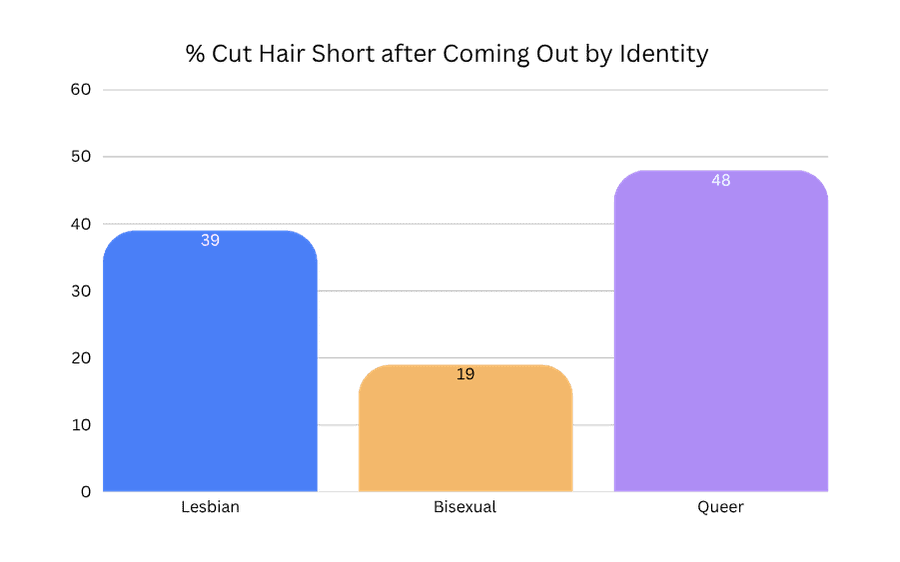
Now the actually interesting chart. Diffs by identity… I don't think this is about hair. I think it's about legibility. DIVA ran a great piece on the big chop last year that framed it less as a style choice and more as an announcement — the thing that makes you visible not just to straight people but, crucially, to us. Everyone is chasing the nod of recognition from another sapphic across the street. Xtra published an essay years back about a haircut that stripped away the option of being comfortably ambiguous, and that's the whole mechanism in one sentence. The chop is not a look, it's a broadcast.
Which maps onto something we already found. Set 3 Quarter 3, carabiners: lesbian and queer users used them at similar rates and bisexual users came in more than 15 points lower. Same shape, different accessory. When a signal is designed to read as "gay," the people whose identity is most often misread by that exact signal have the least reason to fly it, and the most to lose in nuance. Also, and I say this with love, Autostraddle has been documenting the bisexual bob as its own institution for years. Shoulder-length is a haircut too. It is simply not a dramatically shorter one.
Neither route is more valid. Some of us needed the world to know immediately. Some of us needed the world to keep guessing. Both are correct. But if you got the chop and you have the photo, the community would like to see it, purely for research.
Third Date Doctrine 🌹
Next: how many times you should see someone before having sex. Note the wording — this one's a should, not a did. We asked for the norm, not the receipt of you always following it. Keep that in your pocket.
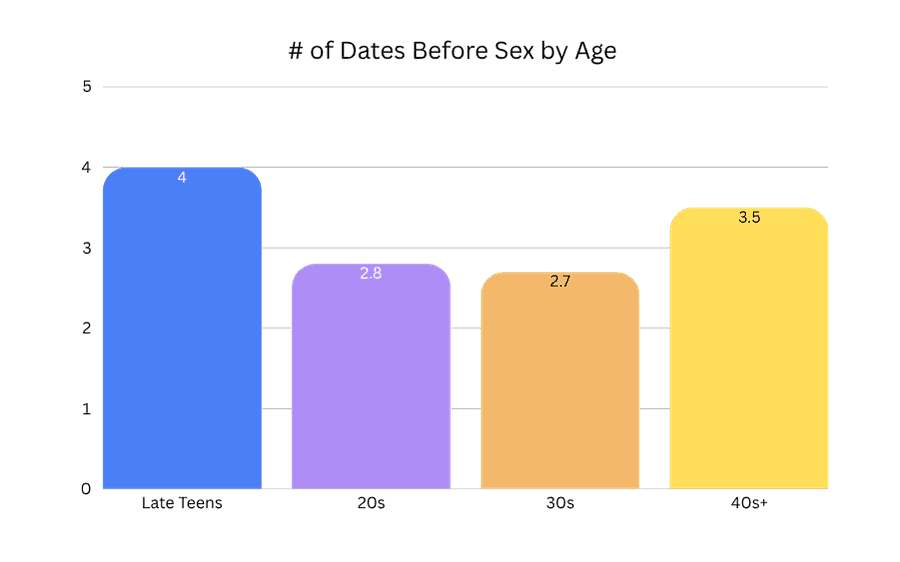
Caution at both ends, efficiency in the middle. The teens have the least experience and the most reason to be careful, and the 40+ group has been around long enough to have a considered opinion instead of a vibe. The 20s and 30s are just out here doing math on a Tuesday.
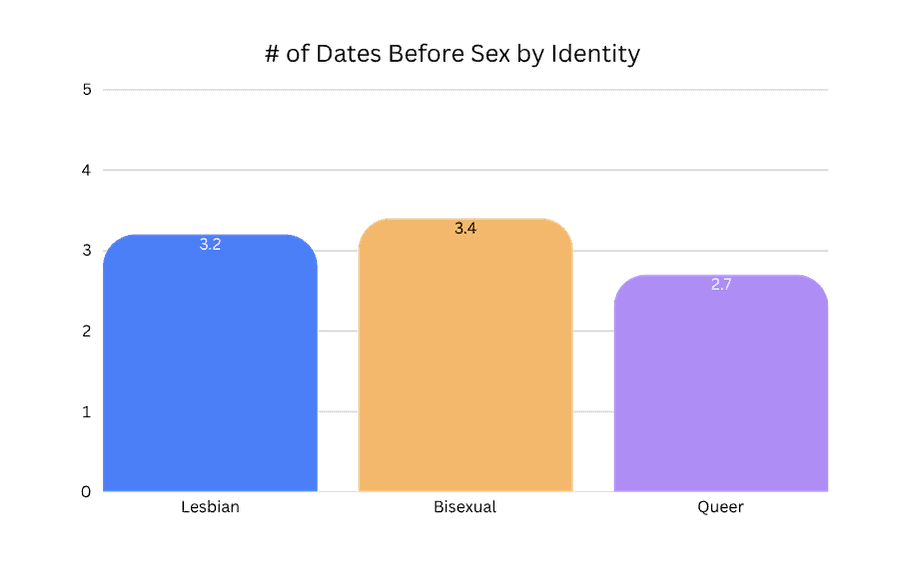
For context, the Kinsey Institute and Lovehoney surveyed 2,200 Americans and got a median of exactly three dates — though only 21% actually picked three, with 38% below and 41% above, so the "rule" is less a rule than a very confident average of chaos. Which means sapphics are landing dead center of the national norm. Boring! Wonderful. Normal.
Except not really. That Groupon/OnePoll survey everyone still cites found women wait an average of nine dates and men five. Nine. And I'd argue that number was never really measuring women's desire — it was measuring a negotiation, one where the waiting is the leverage and somebody's mother's voice is in the room. Take the man out of the equation and the whole apparatus just… evaporates. Two women who both want to have sex have no structural reason to perform reluctance at each other. Turns out the third date rule survives fine on its own merits, it just stops being a rule.
The bisexual number sitting slightly higher makes sense in that light too, since some of that dating happens in contexts where the safety calculus and the script are genuinely different.
And look, three dates to sex, thirty days to "I love you" (Set 4 Quarter 2, where over 60% of you dropped the L-word inside a month). I'm not going to editorialize. I've done that already. You know what you did.
Palm Reading 🤝
Okay. Here's where it gets good.
85% of users said they'd feel comfortable holding hands with a girlfriend on a walk in their own neighborhood. Being gay AF on your own block, no hesitation. That number is genuinely fantastic and I want to sit in it for a second, because the international comparisons are grim. The 2017 UK National LGBT Survey — 108,000 respondents — found more than two-thirds avoid holding hands with a partner in public for fear of a negative reaction. An EU-wide survey put lesbian women at 51% avoiding it. A US LGBTQ Nation poll around the same period had just 40% of respondents comfortable with public hand-holding at all. Against that backdrop, 85% is a genuinely different number.
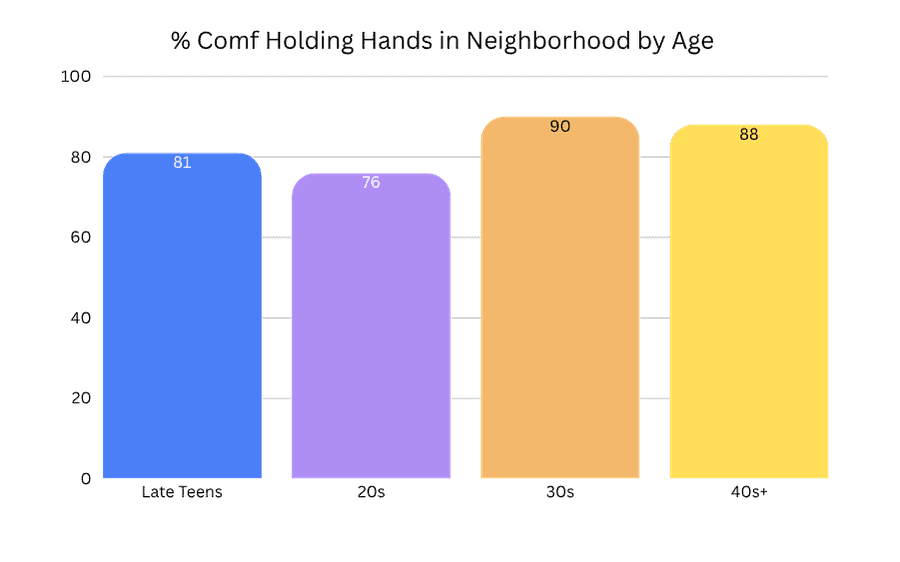
Younger users are the least comfortable, which is maybe not the direction you'd expect. Some of this is logistics — you're more likely to be comfortable in a neighborhood you chose, and choosing your neighborhood is an expensive adult privilege. Some of it is that Set 5 Quarter 3 found younger users reported the highest rates of encountering slurs and nasty comments during Pride month, and Set 6 Quarter 1 found younger users guessed lowest on family support. There's a pattern forming and it isn't a cheerful one. Hang in there, youngins… it really does get better.
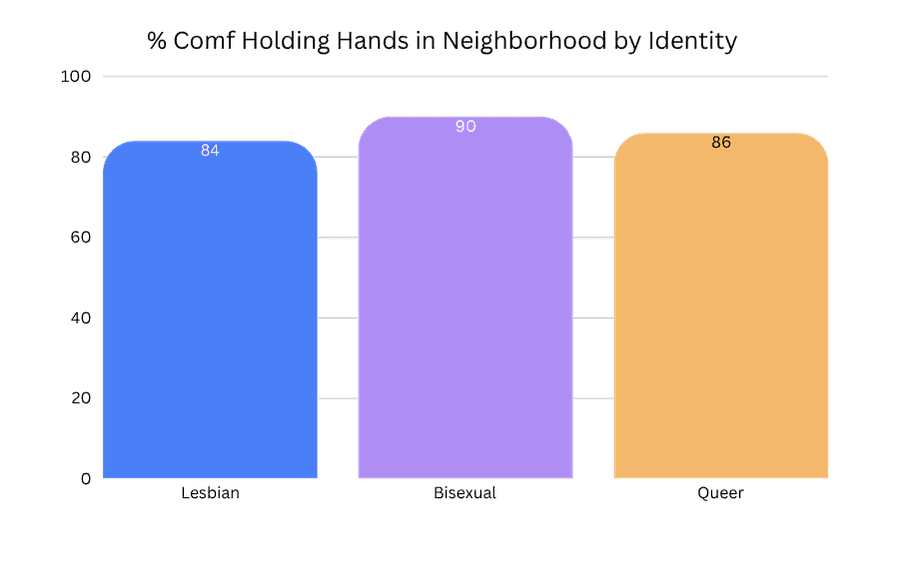
Very tight by Identity. No real story here. Onto the part I actually want to talk about. Our GUESSES. On average, we guessed the answer was 57% for lesbian users, 58% for bisexual users, and 61% for queer users. The real number is 85%. We lowballed our own community by nearly thirty points.
Why? My first instinct is the obvious one: we are estimating from inside Trump's America, and the threat level is priced into the guess. When the news cycle is a rolling inventory of anti-minority nonsense and human rights being rolled back, "would a random sapphic feel safe holding hands outside" starts to feel like a question with an obvious and depressing answer. That same 2017 US poll found 45% of LGBTQ respondents felt they were being treated with more discrimination since the election, and it's not exactly gotten quieter since.
But I think there's a second thing stacked on top, and it's the same bug we keep finding. Look at the question wording again: in your own neighborhood. Not a gas station in an unfamiliar county. Not at the Olive Garden in your hometown. Your block, where you know which neighbor waves. That's the safest public space most of us have, and I suspect a lot of us answered the guess as though we'd been asked about America generally, because that's the version of the question our anxiety had already prepared an answer for.
And then there's selective retention, our old friend from the smoking data and the drinking data and basically every quarter we've ever run. You remember the hate crime story from the news. You also unfortunately recall that one time a guy yelled dyke at you out of his truck window. You do not remember the two hundred walks where absolutely nothing happened, because nothing happening is not a memory. The fear is real and earned and I'm not asking anyone to put it down. But the block-level reality is better than the block-level forecast, and that's worth knowing.
Barstool Bias 🍹
Last one, and it's the same lesson wearing a different outfit. The typical user has just under 2 drinks in an average week.
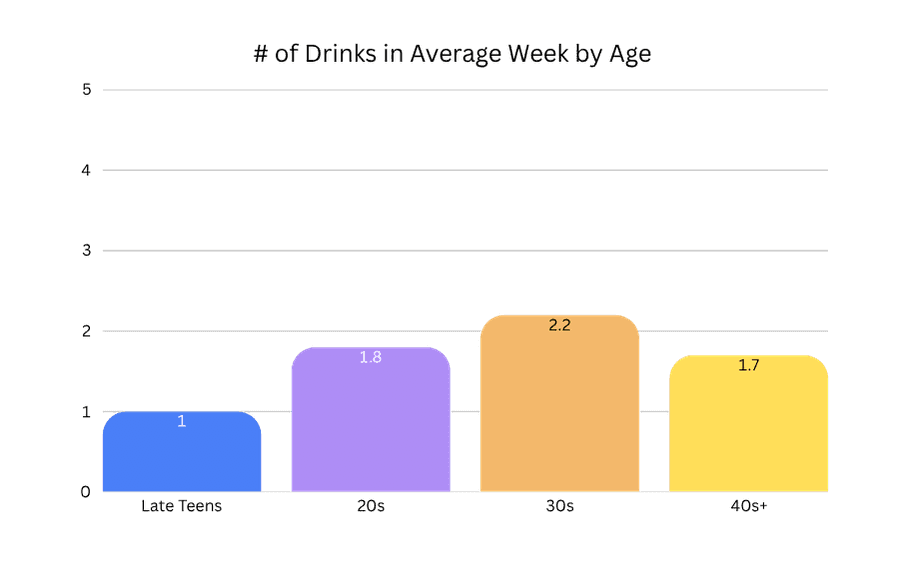
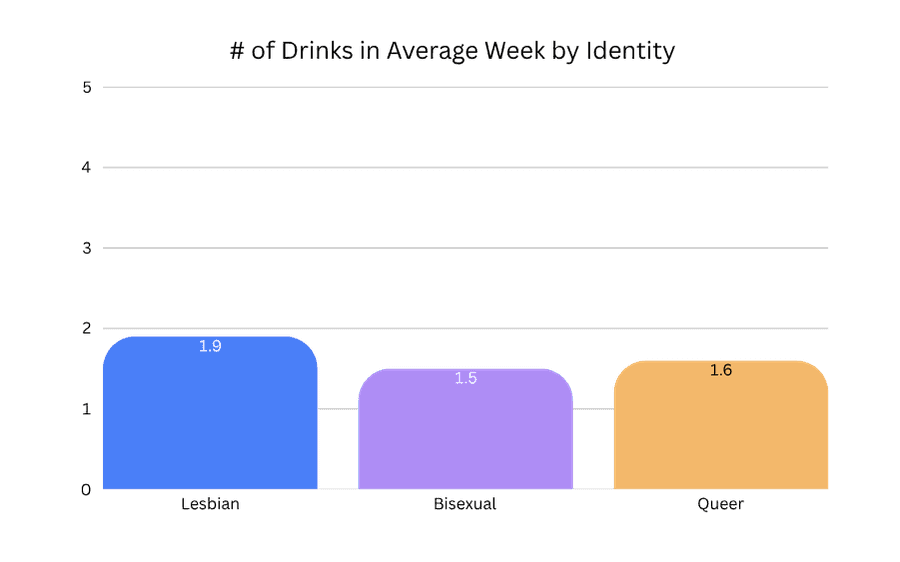
Gallup's 2025 numbers have American drinkers averaging 2.8 drinks a week — the lowest they've recorded since 1996 — and that figure only counts people who drink at all, since just 54% of US adults say they do. Our number counts everybody, drinkers and non-drinkers together. So we are comfortably under the national drinking average while carrying all our teetotalers on our back. The 30s peaking at 2.2 tracks with the general 30s-are-having-the-most-fun pattern we've watched for six sets now. Continue to live it up while not exceeding that low risk drinking guideline (7 or fewer drinks per week for women).
And the guesses were 4 (lesbians), 3.5 (bisexual users), and 3.2 (queer users). Two to three times reality. Again. Here's what kills me: this is the fifth time we've asked about drinking in some form. Set 3 Quarter 1, over 70% of you drink one day a week or less. Set 4 Quarter 2, the heaviest night of the month averaged three drinks. Set 5 Quarter 2, about 70% of you had zero hangovers in a month. Set 6 Quarter 2, 25 alcohol-free days in June, during Pride. Five different angles, same answer every time, and we have overestimated it every single time. At this point the misperception is more consistent than the behavior.
So why? You could connect it to the last section and say we assume everyone's drinking to cope with a country that doesn't want us holding hands in it. Bleak, tidy, and I don't hate it as a theory. But I think the real answer is duller and more interesting: the easiest place to recognize fellow sapphics are in LGBTQ community settings. You know all those queer places that commonly serve alcohol like bars, clubs, and festivals. That's where we're most visible to each other — it's the whole reason to get the chop, buy the docs, and sport the carabiner in the first place. So the sapphics you can actually count are, structurally, the sapphics most likely to be sipping on a cocktail in a safe queer space. Taken further, the wildest public displays of sapphic intoxication (hello Dinah Shore) are also super likely to stick in memory and bias our estimations.
Meanwhile, totally invisible, not memorable and failing to be factored into our estimations: everyone at home…. You know crafting, fixing shit, taking care of plants and pets, exercising, meditating, polishing their carabiners, and of course having tons of orgasms. Most of these popular sapphic activities are tough to pull off at the club and there is only so much time in a day. Despite so many sapphics having a fantastic night at home, they are not showing up in anybody's mental math. Same bug as the hand-holding question, honestly. We estimate the community from the part of it we can see, and the part we can see is selected for being visible. The problem is when we generalize and estimate what everyone is doing based on what is a highly-visible-but-small-in-size minority of the total sapphic population.
At the absolute minimum, we hope this dumb little game is helping us all perceive sapphic reality a little more accurately. That's genuinely the whole point. Everyone is healthier than you think they are, are safer acting gay AF in public than you think they are, and are drinking about half of what you think they are.
Go play the last round of Set 7. Somebody's getting $500.
XOXO SapphicSavvy
P.S. additional reading for the context consumptive
The Coming-Out Chop:
https://diva-magazine.com/2025/08/08/what-is-the-big-chop-and-why-might-it-be-for-you/
https://www.autostraddle.com/86-ways-you-described-your-gay-haircuts-439733/
https://www.autostraddle.com/category/style/lesbian-haircuts/
https://www.buzzfeed.com/skarlan/new-me-new-do
The Third Date Thing:
https://www.sexandpsychology.com/blog/2021/10/25/how-many-people-subscribe-to-the-three-date-rule/
https://today.yougov.com/society/articles/23753-sex-on-first-date-third-date-marriage-poll
https://www.healthline.com/health/healthy-sex/how-many-dates-before-sex
https://time.com/3702516/number-of-dates-before-sex/
Holding Hands in Public:
https://www.tandfonline.com/doi/full/10.1080/19419899.2023.2185533
https://www.psychologytoday.com/us/blog/all-about-sex/202501/is-it-safe-to-hold-hands-in-public-not-for-lgbt-couples
https://www.thepinknews.com/2023/12/04/lgbtq-uk-holding-hands-safety-fear-hate-crime/
https://www.refinery29.com/en-us/2017/10/176363/lgbtq-partners-public-affection-survey
Drinking (Or Not):
https://news.gallup.com/poll/693362/drinking-rate-new-low-alcohol-concerns-surge.aspx
https://news.gallup.com/poll/467507/percentage-americans-drink-alcohol.aspx
https://theconversation.com/the-rise-of-sober-curiosity-why-gen-zers-are-reducing-their-alcohol-consumption-243775
https://www.intomore.com/culture/meet-sober-lesbians-tiktok/