Set 7 - Quarter 2
Codependent, Cohabiting, & Chronically Overdue for a Check-Up

Hello from SapphicSavvy!
We're officially halfway through Set 7, which means the $500 Set prize is halfway to some unsuspecting sapphic’s email. Play the remaining quarters. Somebody is going to win that money, and I would deeply prefer it be one of you who reads these, purely out of favoritism.
Okay. This week we asked about codependence, cohabitation, the childhood best friend you have since re-categorized, and whether you've been to the doctor lately. Buckle up.
Codependence Consensus 🫂
About 73% of you said yes, you've struggled with codependence in a romantic relationship. Now look at this graph.
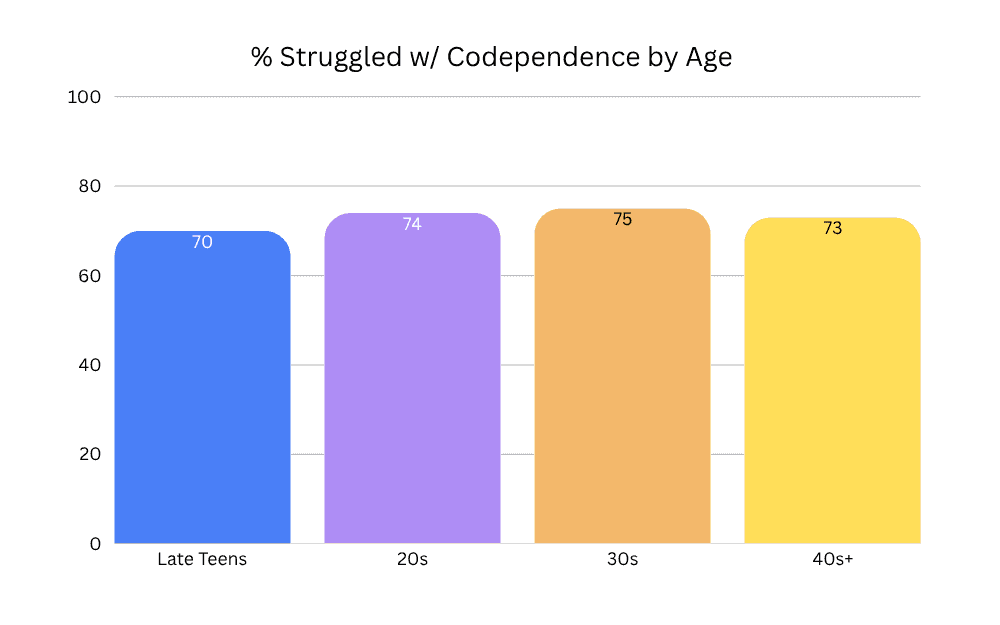
That's not a trend, that's a ruler.
I need you to appreciate how weird this is. This blog has found an age gradient in body hair. In plants. In Subarus, hangovers, Doc Martens, and how many WNBA games we didn't watch. Give us any question and we will find you a generational story about it. And then here's codependence — arguably the load-bearing beam of your entire romantic life — and all four bars land within five points of each other. There's no arc. It just shows up fully assembled at nineteen and never leaves. Renews annually. Never asks about the rent.
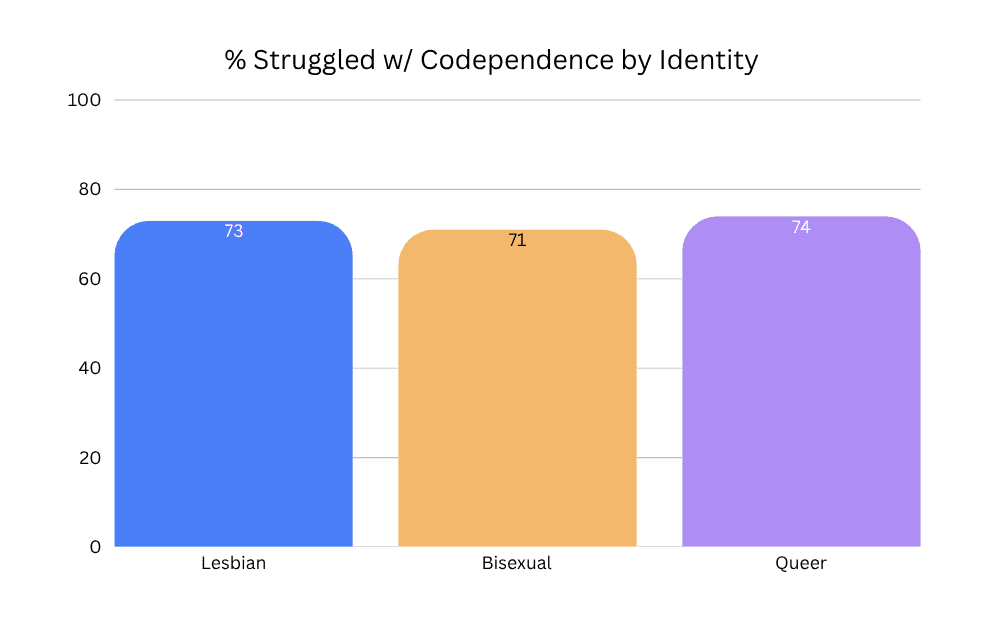
Same deal by Identity. Three bars, three points, one flat line wearing different hats. Usually when results are this uniform I start hunting for the artifact, but I don't think there's one here. I think that's just the number.
Which is funny, because the professionals absolutely called this one wrong. In 1980 two family therapists published a paper on "fusion" in lesbian relationships and the field went yes, that, and then ran with it for two straight decades. One popular book from the era listed off "merger madness" like it was a condition everybody had already agreed existed. Therapists were essentially trained to go looking for it in every couple made of two women, largely before anyone established that it was (a) real, (b) unique to us, or (c) a problem.
Then in 2014 someone finally tested it against different-sex couples. The single difference they found: women in same-sex couples were more likely to want less closeness. Less! Fifty years of getting squinted at for merging too hard and it turns out we were the ones asking for space. Somebody owes somebody an apology and it is not us.
For a national number, such as it is: codependency isn't a formal diagnosis, has no agreed-upon definition, and the stat everyone cites claims up to 90% of Americans show codependent behavior. Which is less a statistic than a mood. But sure! We're under it.
Now, the other half of this, said with love: this is a vocabulary question. To answer yes you have to own the word. And y'all own the word. Set 2 Quarter 2 found half of you in therapy at least monthly, roughly double the national rate for women. Half of you have a professional, a shared language, and a standing appointment. Once someone hands you the term "codependence" you start finding it everywhere — in the ex, in the situationship, in those four months you couldn't eat because she took nine hours to answer a text. That's not a dunk. Naming a pattern is step one of not repeating it. It just means this flat line is probably measuring two things at once: the thing, and how fluent we've gotten at describing the thing. Also, given that 60% of you have said I love you inside of one month (Set 4 Q2) and the typical user has driven 571 miles for a girl (Set 3 Q3), I feel confident there's a real thing under there too.
U-Haul, Unpacked 📦
The average sapphic has shared a home with about 1.4 different partners.

By age, we get the cleanest staircase we've seen in weeks, and the explanation is the boring one: time. You can't have lived with four women if you've only been legally allowed to sign a lease for eleven months. Though shoutout to the late teens sitting at 0.2, because that means roughly one in five of you have already done it, which for an age bracket that may still have a childhood bedroom is a genuinely unhinged amount of commitment per capita. Godspeed.
But let's address the elephant driving the rental truck. The second-date U-Haul joke has been in continuous circulation since it appeared on late-night TV in the early nineties. That bit has been working without a break for thirty years, which is longer than most of the relationships it describes. So here's what the research actually says. Using the How Couples Meet and Stay Together data, female same-sex couples moved in about 1.33 years into the relationship, versus 1.94 years for different-sex couples. Stereotype confirmed! Victory lap! Except the gap vanishes the second you control for age. Those female couples met around 34 on average; the different-sex couples met around 26. Thirty-four-year-olds move faster than twenty-six-year-olds no matter who they're kissing, because thirty-four-year-olds are tired and already own a couch.
And notice the joke is about speed, not frequency. It says we move fast, not that we move often. Our 1.4 is a frequency number and it's aggressively normal: Pew found that among Americans 18–44 who've ever cohabited, 62% have lived with exactly one partner, 24% with two, and 14% with three or more. We are not out here collecting leases. We're doing what everyone does, occasionally on a slightly deranged timeline.
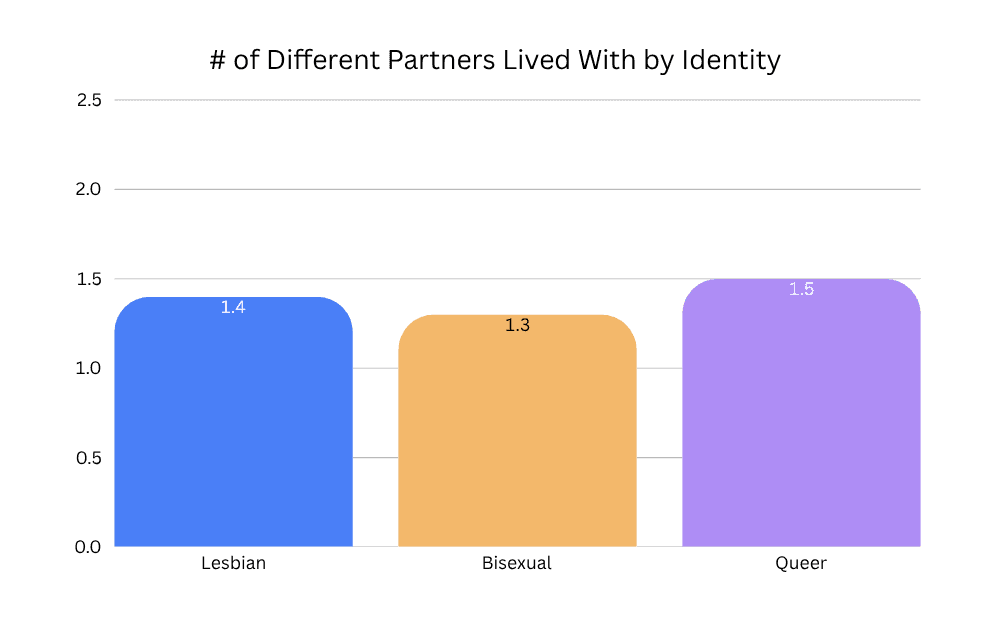
Differences by identity were pretty non-existent… Kind of notable, because our identity groups have differed on a lot of things — plants, poppers, camping, iced coffee, sitting in chairs correctly. Moving in together is one of the only milestones where all three groups just quietly agree. Whatever's driving the lease, it isn't the label.
One caveat before we leave this be: this counts different partners, not good ones. A 3 might be a rough decade and a 1 might be nine years into the best thing that's ever happened to her. Also, last Quarter y'all set the minimum sapphic marriage age at 25.5 while women in same-sex first marriages actually tie the knot around 32 — so the lease is arriving years before the license regardless. Test drive the woman. This is what the U-Haul was for.
Bestie Bombshells 💔
Roughly half of you now realize you were in love with a childhood best friend. And then the age graph goes off a cliff.
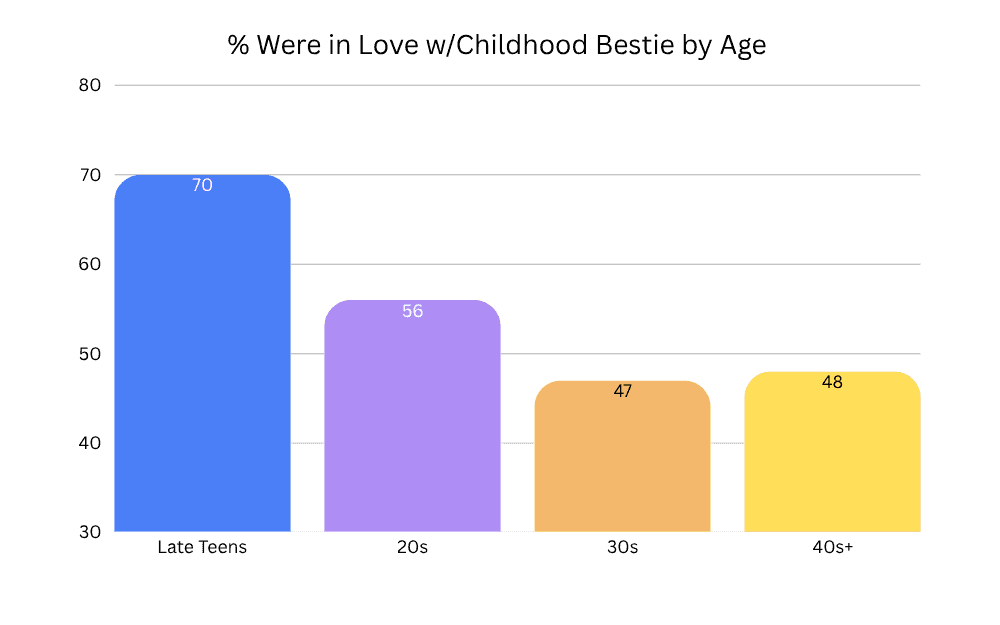
A 22-point drop and then a floor. The words doing all the work here are "now realize." We didn't ask whether it happened. We asked whether you've gone into the archive, pulled the file, and relabeled it. And I think two things are going on, and I don't think they're fighting each other.
First, the obvious one: distance, plus vocabulary. If you're nineteen, your childhood best friend was three years ago and you showed up to this question with the toolkit pre-installed — comphet, the masterdoc, an entire genre of content about the girl you were Weird about in eighth grade. You're not excavating. You're barely reaching. If you're forty-five, that memory has been sitting in a labeled box since the Clinton administration, and relabeling a thirty-year-old memory takes an actual act of will plus a specific prompt. Like, say, a survey question in a sapphic trivia app.
Second, and this is the one I like more: it's not purely retroactive. Younger sapphics are increasingly doing the realizing live, which means fewer of these feelings get buried in the first place. Set 3 Q4 found younger users overwhelmingly googling "girls kissing" before coming out. Set 3 Q2 found coming-out age dropping with every cohort. When recognition shows up faster, more of it lands while the friendship is still happening, and "I had a crush on her" never gets to become a twenty-year mystery.
Stack those together and that 47–48% floor stops reading as older sapphics had fewer intense friendships. They had exactly as many. They got filed under the only heading available at the time, and about half those files have since been reopened. The rest may still open. Files do that. Usually at 2am.
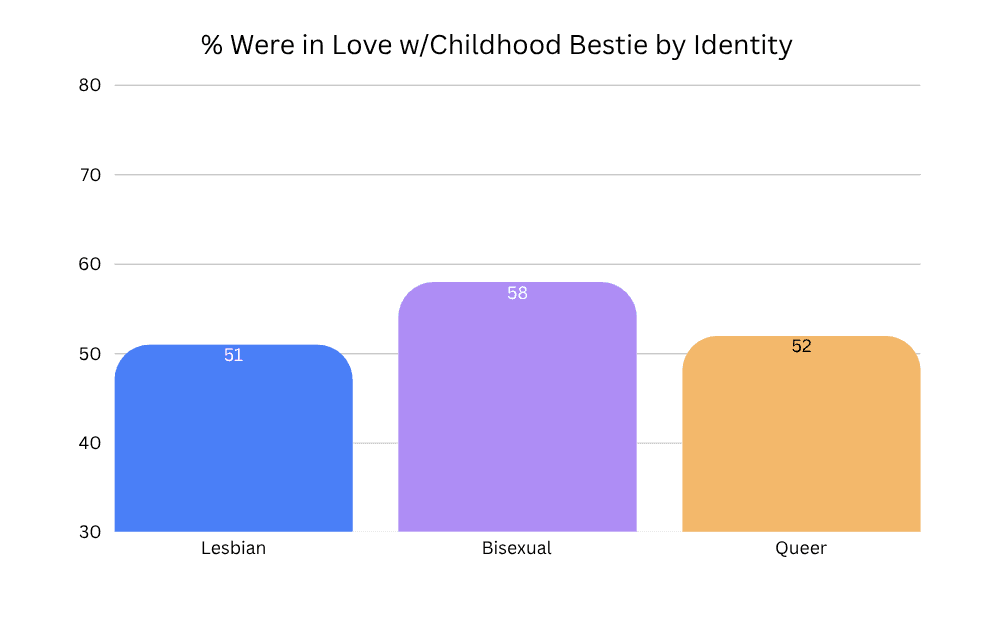
Breaking down by identity, we see bisexual users out front, and here's my reckless speculation for the week: for a lot of lesbians, the childhood bestie got reclassified decades ago as The First Sign, which is a whole different memory than "one of several formative crushes." Bisexual users might have more room to let a feeling have been love without it needing to be the origin story of an entire identity. Not every crush has to be the inciting incident. Some of them get to just be a girl.
For scale, though: Set 5 Q1 had about 90% of you crushing on a fictional female character as a kid. Ninety for the cartoon, fifty-two for the actual girl. Which tracks flawlessly, because Shego cannot reject you, cannot start dating a guy named Trevor, and does not have your mother's phone number. Autostraddle has called falling for your friend a queer rite of passage and frankly the numbers agree. If she's reading this: hi. We were nine. It's fine.
Check-Up Check-In 🩺
Quick behind-the-curtain note, because we like showing our work. We actually asked how many months since your last wellness exam, and the averages came back nearly identical across every group, which makes for a deeply boring chart. So we flipped it to the share of you who've been within twelve months, which is the actual guideline and a much better picture.
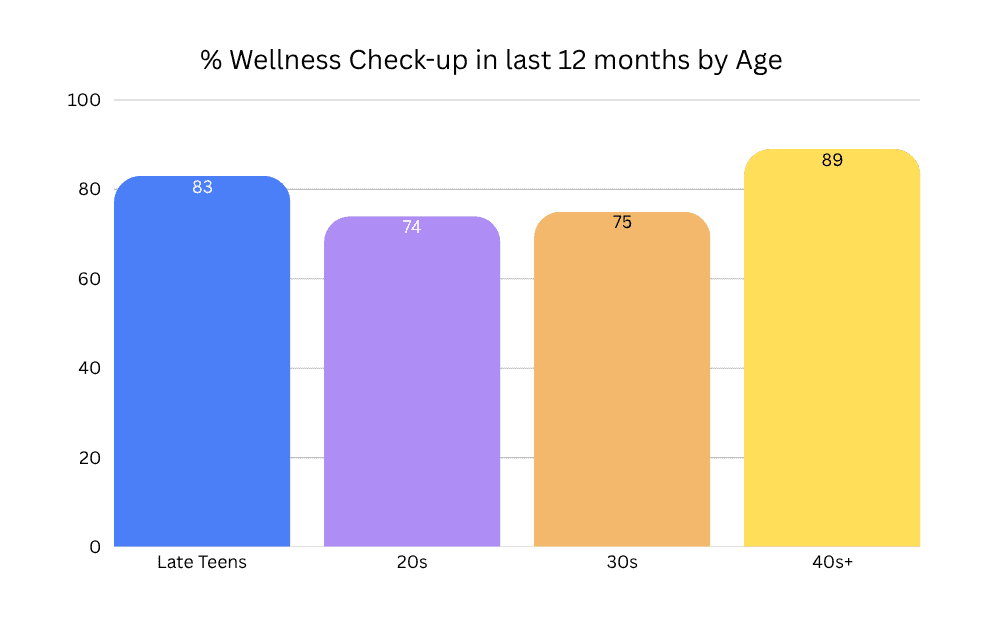
That's a U shape rarely observed here at SS Headquarters, and here's my theory about it: at both ends of that graph, somebody else is booking the appointment. Late teens are still inside a system that schedules you — school forms, sports physicals, a parent with a calendar, an office that calls the house. Users 40+ have aged into a different system that also schedules you, because the screening machinery starts pinging around 40 and does not let up. The dip in the middle is the gap where you are the only person who will ever make that call and nobody notices if you don't. I say this as someone with "find a PCP" on a list I wrote in March.
For comparison, state BRFSS data puts women's routine-checkup-in-the-past-year rate around 74% (men: about 66%). So our 20s and 30s are landing dead on the national number for women, and the 40+ crowd is beating it outright. Elders, as usual, showing off.
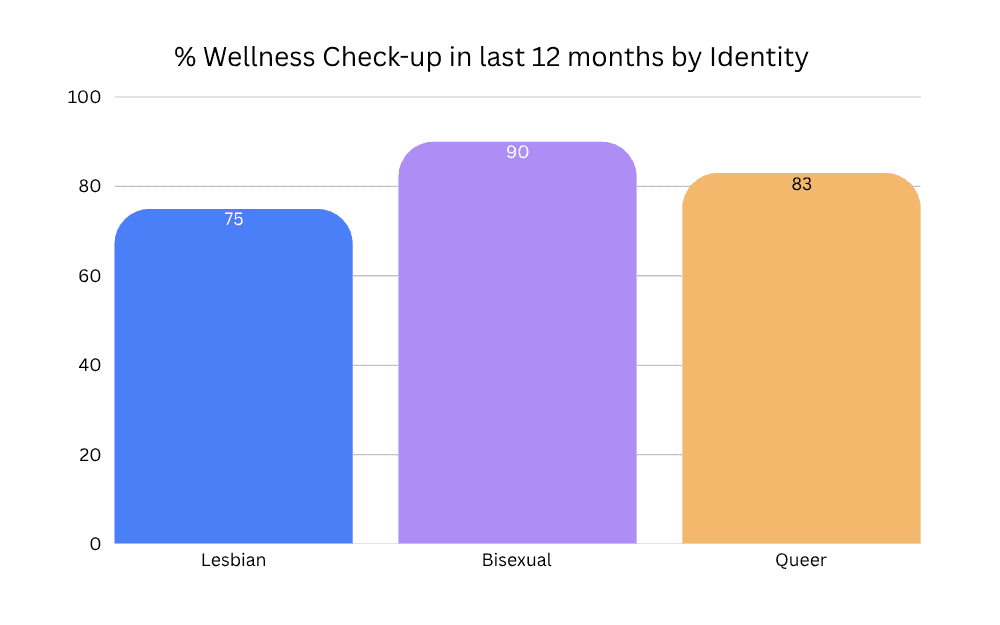
This one actually has teeth, because the same exact ordering shows up nationally. An analysis of National Health Interview Survey data found sexual minority women were about 40% less likely than straight women to have ever had a Pap test — and within that group, lesbians were roughly 50% less likely than bisexual women. Our 15-point gap is the same gap, just smaller and inside our own house. The mechanism, as best anyone can tell, is that "sex" gets defined heteronormatively at every level. If the intake form, the risk script, and the general cultural idea of who needs screening are all built around penises, and there are no penises in your life, the whole preventive apparatus quietly files you under Probably Fine. Worse, a lot of us have absorbed that and now believe it about ourselves. So let me be extremely unfunny for one sentence: HPV does not care who you sleep with, cervical cancer screening guidelines apply to you regardless, and this is one of the most common and most expensive pieces of misinformation floating around sapphic health.
There's a nice wrinkle in our own back catalogue, too. Set 4 Q4 found bisexual users were the group least likely to be out to a primary care provider — and now they're the group most likely to have actually seen one this year. Which sounds like a contradiction and might just be the same machine running from both ends: a system that reads you as a straight woman will hunt you down with reminders about pap smears and birth control, and staying unread is uncomfortable but frictionless. Nobody wins that trade cleanly. One group gets scheduled and doesn't get seen. Another gets seen and doesn't get scheduled.
It also lines up with Set 5 Q4, where about three-quarters of you were up to date on preventive screenings. Two different Sets, two different phrasings, same number. That's about as close to a Real Finding as this blog gets, and I'm putting it on the fridge. So consider this your nudge. Yearly wellness exam, screenings appropriate for your age. And if you've had a bad time with a provider before — about 29% of lesbian and bisexual women report delaying care versus 18% of straight women, so statistically, many of you have — there's an LGBTQ+ healthcare directory in the links below that'll help you find someone who doesn't need you to explain yourself first. Go get your bloodwork. You'll be insufferable about it for a week and you will have earned that.
That's everything I've got. Codependent, cohabiting, retroactively heartbroken, and 80% current on our physicals. Honestly? Not the worst thing a community could be.
See you in the app (& hopefully on the leaderboard),
XOXO SapphicSavvy
P.S. some additional reading, if you are into that sort of thing:
Codependence & the Fusion Myth:
https://onlinelibrary.wiley.com/doi/abs/10.1111/j.1545-5300.1980.00277.x
https://journals.sagepub.com/doi/abs/10.1177/0361684313475877
https://www.autostraddle.com/
https://www.therecoveryvillage.com/mental-health/codependency/codependency-statistics/
The U-Haul Question:
https://www.intomore.com/culture/it-turns-out-lesbians-dont-actually-u-haul-much-quicker-than-anyone-else/
https://gomag.com/article/breaking-news-the-lesbian-u-haul-stereotype-is-false/
https://www.pewresearch.org/social-trends/2019/11/06/the-landscape-of-marriage-and-cohabitation-in-the-u-s/
https://www.refinery29.com/en-gb/uhaul-lesbian-queer-women-myth
In Love With Your Best Friend:
https://www.autostraddle.com/the-ultimate-guide-to-having-a-lesbian-crush-on-your-friend/
https://www.autostraddle.com/you-need-help-in-love-with-your-best-friend/
https://www.autostraddle.com/9-lesbian-falls-for-her-best-friend-tv-storylines-from-heart-wrenching-to-heart-warming-314990/
Wellness Exams & Sapphic Health:
https://www.ncbi.nlm.nih.gov/pmc/articles/PMC9766763/
https://www.uclahealth.org/news/release/even-with-health-insurance-lesbian-gay-and-bisexual-adults-are-more-likely-to-delay-medical-care
https://www.cdc.gov/pcd/issues/2014/14_0126.htm
https://lgbtqhealthcaredirectory.org/