Set 9 - Quarter 3
💊 Birth control, 🫥 Blackouts, 🏳️⚧️ Trans Friends, and 🖋 Tattoos
Hello from SapphicSavvy!
Set 9, Quarter 3. This week: birth control, blackouts, trans friends, and tattoos.
Let's go.
💊 Pill Talk
28% of you use some form of birth control.
Y'all guessed 41%.

Lesbian 25%, bisexual 30%, queer 35%.
You guessed for your own identity group, and every group guessed high:
Lesbians guessed 34%. Real: 25%.
Queer users guessed 51%. Real: 35%.
Bisexual users guessed 58%. Real: 30%.
Bisexual users nearly doubled their own number. I think I can see the math: bi means sometimes dating men, and dating men means birth control. Makes sense on paper. But in reality, only five points separate bi users from lesbians.
Which raises the obvious question. If a quarter of lesbians are on birth control, what is it controlling?
Mostly periods. The Guttmacher Institute found that 58% of pill users rely on it at least partly for reasons other than preventing pregnancy: cramps and period pain (31%), regulating their cycle (28%), acne (14%), and endometriosis (4%). About 762,000 American women who have never had sex are on the pill, and 99% of them are on it for something other than contraception. "Birth control" is a name that covers about half the job.

Late teens 52%, 20s 32%, 30s 31%, 40s+ 12%.
That's a 40-point slide from youngest to oldest. Our late teens are the only group where more than half are on something. For the 40s+, it's about one in eight.
The guesses didn't slide with it. Late teens guessed 45% for their identity group, the 20s guessed 43%, the 30s 42%, and the 40s+ 38%. Everyone pictured roughly the same community, about 40% on birth control, whether or not anyone their own age actually was.
Why are the late teens so far ahead? Guttmacher again: among pill users aged 15 to 19, 82% use it for non-contraceptive reasons, and a third use it only for that. Speculation, clearly labeled: the late teens are fresh off the "you have cramps and acne, here's a pill pack" era of their first gyno appointments, and a lot of people come off hormones or switch things up as they get older. Also, 52% of our late teens is 13 people, so hold the exact number loosely.
For national context, CDC data from 2017–2019 found 65% of women aged 15 to 49 currently use some form of contraception. For women in their 40s it's 75%, and more than half of that is sterilization. Our 40s+ are at 12%. Turns out not sleeping with men is an extremely effective form of birth control. Who knew.
Back in Set 4 Quarter 4, we wrote an entire Miley Cyrus parody about coming out to your doctor and still getting handed the pregnancy test cup. Turns out the birth control question at the doctor's office isn't only a straight-people question either. A lot of you are on it for reasons that have nothing to do with who you're sleeping with.
Sincere beat, on purpose: if you're on birth control to manage something (pain, heavy periods, PCOS, endometriosis), tell your doctor that's the reason, so they're treating the actual thing. And if any of your partners can get you pregnant, don't assume you're covered because the label on your profile says sapphic.
🫥 Fade to Black
10% of you have blacked out from drinking in the past year. That's 20 people out of 200.
Y'all guessed 23%. Quick vocab check, because these two get mixed up a lot: blacking out isn't passing out. During a blackout you're awake. You're talking, ordering another round, maybe texting an ex (Set 5 Quarter 2 taught us some of you do that anyway). Your brain just isn't recording any of it. The NIAAA describes two kinds: fragmentary (spotty memories, as in "wait, how did we get to the second bar?") and en bloc (hours gone completely, and they're not coming back).

Late teens 12%, 20s 18%, 30s 7%, 40s+ 5%.
You guessed for your own age group:
Late teens guessed 35%. Real: 12%.
20s guessed 32%. Real: 18%.
30s guessed 18%. Real: 7%.
40s+ guessed 16%. Real: 5%.
Last week I introduced the SapphicSavvy 2x rule: however much you think your friends are partying, cut it in half. This week, the rule was too generous. The late teens and the 40s+ were off by about three times.
The 20s came closest, and they're also the group with the highest real number, almost one in five. The 20s know their own.
The late teens are interesting, though. Last week they told us they go out the most (3 nights a month). But in Set 6 Quarter 2, our youngest users had the most alcohol-free days of anyone. And this week, they're nowhere near the top for blackouts. Going out a lot and drinking a lot are two different things. Also, 12% of our late teens is three people, so don't build a theory on it.
For context, a national study (Hingson et al., 2016) followed young people from 10th grade onward. One year after high school, 20% of those who drank had blacked out in just the past six months. An older Duke study of college students found that 40% had blacked out in the past year. Our late teens are at 12% for the whole year, and our 20s at 18%. Both numbers sit under those benchmarks, even though they're the highest in our community.
Women are at higher risk. The NIAAA says women tend to hit a higher blood alcohol level per drink, and to hit it faster. After adjusting for other factors, the Hingson study found young women had higher odds of blacking out than young men.

Lesbian 11%, bisexual 7%, queer 8%.
Each identity group guessed about its age peers, and all three guessed basically the same thing: lesbians 24%, bisexual users 22%, queer users 24%. The real answers were all around a third of that.
Lesbians are a few points ahead. That matches Set 5 Quarter 2, when lesbians reported the most hangovers, and last week, when they were a hair ahead on nights out. It also matches the outside research. A University of Maryland study in LGBT Health found lesbian and bisexual women were two to three times more likely than straight women to binge drink at high intensity. Bisexual users came in lowest this week, but 7% is two people. Small group, small number, big grain of salt.
So why did we guess more than double? Because a blackout happens once and then gets retold for years. "Remember the night she..." stories have a very long shelf life. Nobody tells the story of the night everyone went home at midnight and remembered all of it. It's the same visibility problem from Set 7 Quarter 3. Back in Set 3 Quarter 4, I said we remember the nights that stand out and forget the normal ones. Still true.
Sincere beat, on purpose: a blackout means you drank enough that your brain stopped making memories. Research on young adults finds blackouts predict other drinking-related harms. In Set 6 Quarter 4, a little under half of you said you'd ended up in a sexual situation you regretted while drunk or high. If you're going to drink, eat first, pace yourself, alternate with water, and keep an eye on your people. There's one bit of hopeful news: a 2026 study of college drinkers found blackouts didn't predict heavier drinking later, and in one sample, students who had blacked out actually drank less afterward. The authors suggest a blackout can be a turning point. If one recently scared you, listen to that. And if they're happening a lot and you want that to change, that's worth talking to someone about. We have resources on the support page of the app.
🏳️⚧️ The T in the Group Chat
The typical user has about 3.9 trans friends.
Y'all guessed 2.9.
This is the only question this week where we guessed low.
For national context, Pew found in 2022 that 44% of American adults personally know someone who's trans, and 27% have a trans friend. Our typical user is past "knows someone." She has about four. (The spread on this one was wide, so some of you are carrying the average. Thank you for your service.)

Late teens 6.1, 20s 3.3, 30s 3.6, 40s+ 3.8.
You guessed for your own age group, and every age group guessed low:
Late teens guessed 3.9. Real: 6.1.
20s guessed 3.0. Real: 3.3.
30s guessed 3.0. Real: 3.6.
40s+ guessed 2.4. Real: 3.8.
The late teens lead by a mile. That tracks with the bigger picture: Pew found about 5% of adults under 30 are trans or nonbinary, and Gallup's 2025 report has nearly a third of Gen Z women identifying as LGBTQ+. Your friend group at 19 looks very different from your friend group at 39 did.
But look at the 40s+. They gave the lowest guess of any age group, and they came in second highest. That's the third time in two Sets that the 40s+ have sold themselves short: the three- month U-Haul in Set 8 Quarter 4, age gaps last week, and now this. At this point it's a recurring bit. 40s+, you are cooler than you think you are.
I have a theory about where the low guess comes from. There's a loud storyline about older lesbians and trans women being at odds, and it gets a lot of airtime. Back in Set 6 Quarter 2, we talked about how a small, very online slice of any group can drown out what's typical. Same thing here. The loud version gets the headlines, while the 40s+ quietly have almost four trans friends each.

Lesbian 3.6, bisexual 2.3, queer 5.4.
Each identity group guessed about its age peers, and they all landed in the same low spot: lesbians 2.9, bisexual users 2.9, queer users 3.1.
Queer users lead, which makes sense. "Queer" is a label a lot of trans and nonbinary people use themselves, and queer spaces tend to overlap.
Lesbians came in at 3.6, right at the community average. In 2018, after a wave of anti-trans pieces in the media, DIVA, Autostraddle, Curve, and other lesbian publications signed a joint statement called "Not In Our Name." One line: "Trans women are women, and trans people have been at the forefront of so many LGBQ activist movements over the years." This week's data is on their side.
Bisexual users came in lowest. That fits Set 9 Quarter 1, when bisexual users also reported the fewest close sapphic friends (2.6). One possible explanation: bi users may be less plugged into queer friend networks in general, whether that's because of who they date or because queer spaces don't always make bi people feel like they belong (we got into bi invalidation back in Set 6 Quarter 3). Speculation, and a group of 27, so hold it loosely.
One more thing. In Set 9 Quarter 1, the typical user had 3.6 close sapphic friends. This week, 3.9 trans friends. They're different questions (trans friends don't have to be close, or sapphic), so please don't do math on it. But the group chat is clearly bigger than any one label.
Sincere beat, on purpose: it's a heavy time to be trans in this country. Text your trans friends. Not as a wellness check or a project. Just because.
🖋 Skin in the Game
The typical user has 4.4 tattoos.
Y'all guessed 5.5.
This question asked you about your own identity group and your own age group.

Lesbian 4.2, bisexual 2.4, queer 5.9.
Queer users guessed 5.88. Real: 5.92.
Lesbians guessed 5.35. Real: 4.2.
Bisexual users guessed 5.33. Real: 2.4.
Queer users, that's off by 0.04 of a tattoo. A dot. A stick-and-poke at most. That might be the best guess we've seen all Set.
Bisexual users guessed more than double their real number. Babes. Two weeks in a row now. Look at your own data.
The ranking (queer first, lesbians second, bi third) is older than this app. Autostraddle surveyed more than 12,000 readers in 2018 and found 56.5% of queer respondents had a tattoo, compared with 46% of lesbians and 44% of bisexual respondents. Same order, eight years later.
National numbers back up the stereotype, too. Pew's 2023 survey found 32% of all American adults have a tattoo. Among lesbian, gay, and bisexual women, it's 68%, and 55% have more than one.
And it goes way back. According to the same Autostraddle piece, lesbians in the 1940s got nautical stars on their inner wrists, a spot they could hide under a watch. One mid-century tattoo artist refused to tattoo straight women unless their husbands came along, but lesbians, who "already had transgressed those boundaries," were fair game. That made lesbians some of the first American women to get tattooed at all. Respect to the originals.
(Our original SapphicSavvy correspondent confessed to "several plant-related tattoos" back in Set 3 Quarter 1. We assume she's counted in here somewhere.)
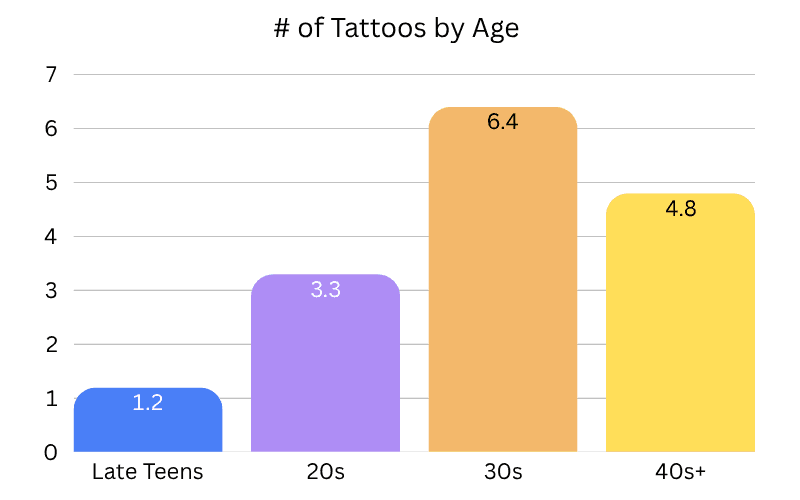
Late teens 1.2, 20s 3.3, 30s 6.4, 40s+ 4.8.
Late teens guessed 4.1. Real: 1.2.
20s guessed 5.7. Real: 3.3.
30s guessed 6.2. Real: 6.4.
40s+ guessed 5.2. Real: 4.8.
The 30s and 40s+ were close. The 30s even guessed a little under. The younger two groups overshot by a lot. The late teens tripled their real number. You usually have to be 18 to get tattooed, so our late teens have had a year or two of legal access at most. Give it time. And money.
And yes, the 30s are in first place again. Last week we listed what the 30s have topped so far: 3+ orgasms in a session, squirting, polyamory, and calling home 12 days a month. Now add "most ink." Pew found tattoos peak for adults 30 to 49 (46%) and drop to 25% for adults 50 to 64, so our 40s+ dipping below the 30s fits the national pattern too.
🧵 The Thread
Here's how the guesses went this week:
Birth control: guessed 41%, real 28%. Too high.
Blackouts: guessed 23%, real 10%. More than double.
Tattoos: guessed 5.5, real 4.4. Too high.
Trans friends: guessed 2.9, real 3.9. Too low.
Three overs and one under. Two of the overs are things that turn into stories. A blackout happens once and gets retold for years. A sleeve is visible from across the room, and a bare arm isn't. (The third, birth control, was mostly bi and queer users doing the "we date men sometimes" math on themselves. More on that below.) The under is the thing that doesn't turn into a story at all. Nobody posts "got coffee with my trans friend, normal Tuesday." Friendship doesn't go viral. It just keeps happening.
That's the visibility problem from Set 7 Quarter 3 again, with a twist. We don't only overcount what's loud. We undercount what's quiet.
Two running storylines also kept going this week:
Bisexual users overshot themselves again. They nearly doubled their own birth control number (58% vs. 30%) and more than doubled their own tattoo count (5.3 vs. 2.4). Meanwhile, they reported the fewest blackouts, the fewest trans friends, and the fewest tattoos of any identity group. It's a group of 27 people. But last week bi users gave the highest guesses on oral and on partying and came in lowest on both. This week it was birth control and ink.
The 40s+ undersold themselves again. U-Haul, age gaps, and now trans friends. Three times in two Sets.
So here's the real typical sapphic of Set 9 Quarter 3. She's probably not on birth control, and if she is, it's for her cramps. She did not black out this year. She has about four trans friends. And she has about four tattoos.
Not a cautionary tale. Honestly? Kind of a catch.
One more round left in Set 9. Go play it.
XOXO SapphicSavvy
P.s. here's some additional reading if you're so inclined:
Pill Talk:
https://www.guttmacher.org/news-release/2011/many-american-women-use-birth-control-pills-noncontraceptive-reasons
https://www.cdc.gov/nchs/products/databriefs/db388.htm
https://www.helloclue.com/articles/sex/why-queer-bisexual-and-pansexual-people-use-birth-control
Fade to Black:
https://www.niaaa.nih.gov/publications/brochures-and-fact-sheets/interrupted-memories-alcohol-induced-blackouts
https://pmc.ncbi.nlm.nih.gov/articles/PMC4820355/
https://pmc.ncbi.nlm.nih.gov/articles/PMC13385469/
https://sph.umd.edu/news/dangerous-disparity-new-research-shows-heavy-drinking-risks-sexual-minority-women
The T in the Group Chat:
https://www.pewresearch.org/short-reads/2022/06/07/about-5-of-young-adults-in-the-u-s-say-their-gender-is-different-from-their-sex-assigned-at-birth/
https://www.autostraddle.com/not-in-our-name-a-statement-on-trans-inclusion-from-leading-lbq-womens-publications-443684/
https://www.nbcnews.com/nbc-out/out-news/nearly-1-10-us-adults-identify-lgbtq-gallup-survey-finds-rcna192910
Skin in the Game:
https://www.pewresearch.org/short-reads/2023/08/15/32-of-americans-have-a-tattoo-including-22-who-have-more-than-one/
https://www.autostraddle.com/?p=438565